
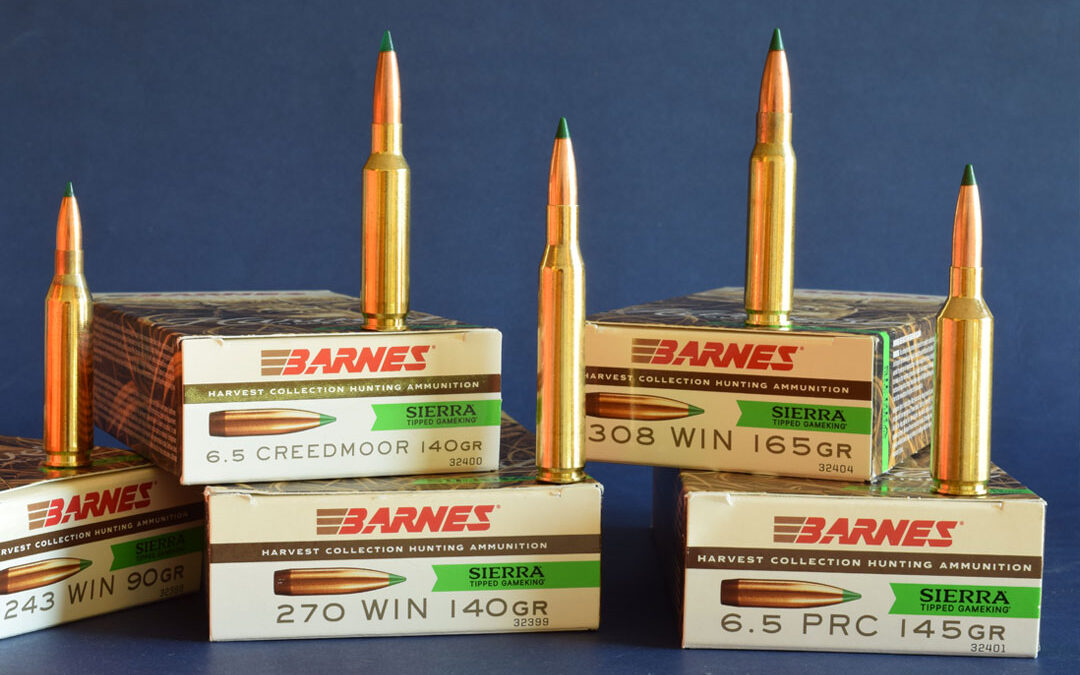
Deer hunters don’t need exotic, expensive ammo, just accurate, reliably lethal loads. Herewith an update!
Hitting far-off targets, informally or in competition, has shooters spending wildly on rifles, ammo and optics. Per backyard mechanics burying speedometer needles on straight pavement Saturday nights, utility matters not. The joy lies in testing limits.
But as popular as long-range shooting has become, more rifles earn their keep during deer season at unremarkable yardage. In 1918 James Jordan used a 25-20 Win. to kill a whitetail whose antlers dwarfed all others for most of a century. Eight years on, the mule deer downed by Edwin Broder’s 32 Special topped Boone and Crockett’s non-typical list. Still does. Both deer fell to blunt bullets from open-sighted rifles.
The form and color of poly-tip bullets, pioneered in the 1960s, sell regardless of their ballistic acumen.
Deer haven’t changed much since. Neither have the black bears that, in my youth, bent meat poles in Michigan whitetail camps. New Winchester Model 94 and Marlin Model 336 “deer rifles” then fetched less than $90. The price of bliss has, alas, risen with ballistic coefficients. But beloved traditional cartridges are showing up with traditional soft-nose bullets in fresh boxes. Deer hunters take heart!
Some of these loads are ancient in name—with or without improved powders and incremental tweaks in bullet design. A Winchester Power-Point killed my first deer; I’ve since used Power-Points in handloads as well as factory ammo. They shoot well in various rifles and plow lethal channels in deer—deep enough to destroy vitals on quartering bucks.
Remington’s Core-Lokt is another champ. Designed in the 1930s, it’s still available in pointed and round-nose profiles. Double-diameter upset is normal, and its mid-shank pinch does help keep core and jacket together. Like Power-Points, Core-Lokts have taken elk for me, from cartridges as modest as the 250 Savage. Hornady’s InterLock is similar and as reliably lethal. Sierra’s GameKing, Speer’s Hot-Cor, Federal’s Power-Shok—even Nosler’s impact-extruded Solid Base—are relatively easy bullets to make and to sell profitably at attractive prices. Depending on the load and rifle, they’re not only capable of fine accuracy but may nip smaller groups than flossy poly-tip bullets with BCs shouting from the box.
Where Dakota prairie gives way to badlands, deer see you far off—then vanish in the landscape’s myriad humps and fissures. The buck I spied at dawn three seasons ago was snaking his way up coulees toward castle-top buttes. Waiting until he’d slipped behind a cone, I dodged into a cut, then hurried after him. So it went for half an hour, as incrementally the gap between us shrank. Then, peeking over the lip of a ravine, I caught the glint of antler. At 300-odd yards, he offered just enough shoulder. Steadying my Holehan-built 25-06, I watched as the crosswire jumped and the buck vanished.
That mule deer didn’t fall to a sleek poly-tip bullet with a BC higher than a loan shark’s interest rate, but to a Hornady InterLock bullet of traditional design. It comes in affordable ammunition that drills snug groups from my Weatherby 25-06 and has taken other far-off deer. Why change?
New to the Woods
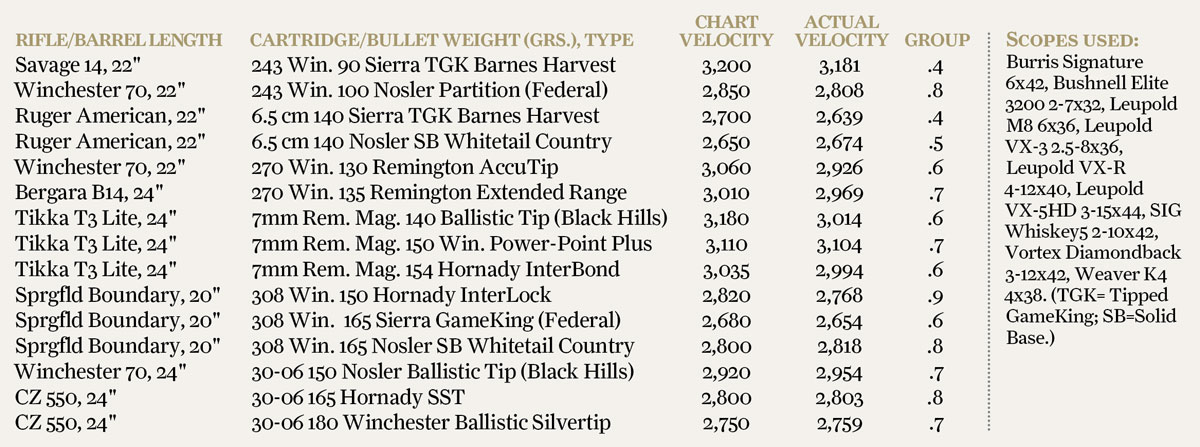
In my youth, Winchester, Remington and Federal didn’t tell you what to shoot with their ammo. Hunters grew up matching loads to game, or just using what came to hand. The ammunition business is now intensely competitive; for a given cartridge there may be more loads from a single manufacturer than there were industry-wide short years ago! Cartridge boxes now wear alluring images of antlers, and labels that, like automobile monikers, buttonhole customers: Hornady’s American Whitetail, Winchester’s Deer Season and the new Barnes Harvest Collection and Nosler Whitetail Country. These loads are modestly priced and well finished. My range trials have showed they—and other “ordinary” deer loads—are more than peppy and accurate enough to match, or even trump, costlier options. Mostly I used rifles and scopes common in deer camps to check velocities (in fps, with a Garmin Xero C1 Pro chronograph) and record the best 3-shot, 100-yard group in inches.
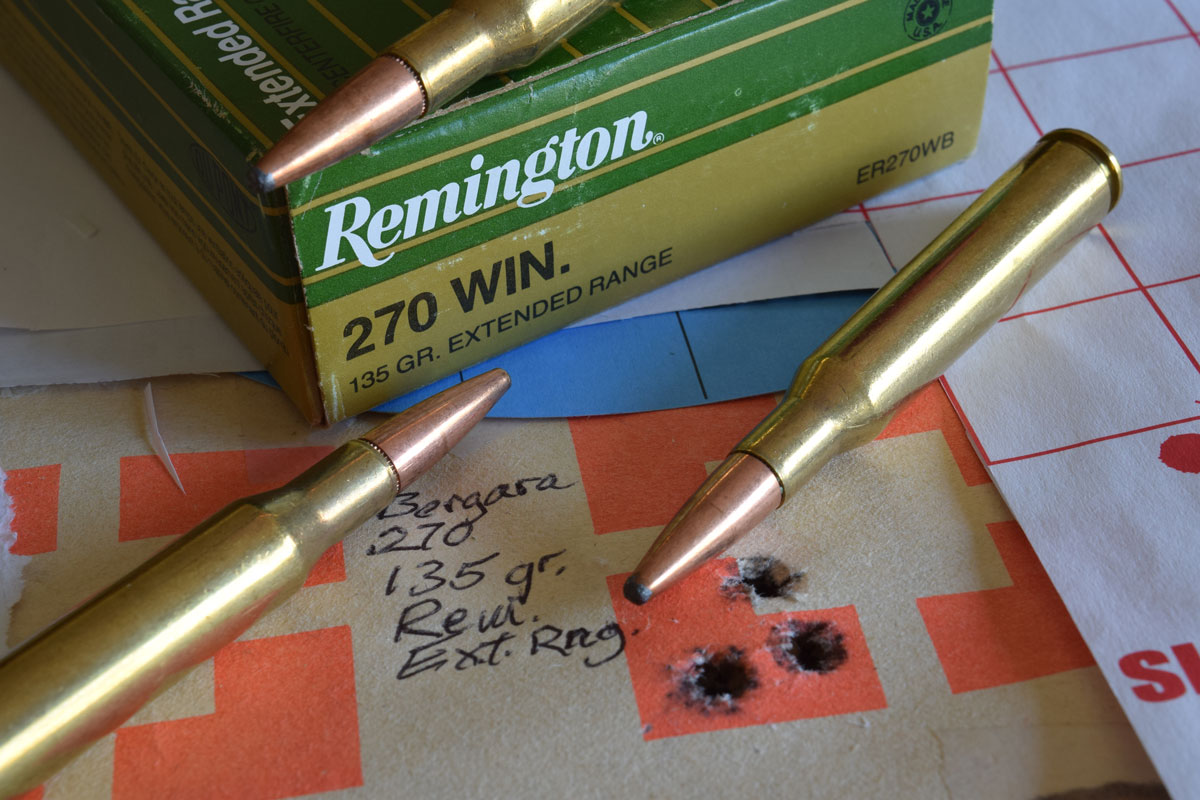
No longer listed, this Remington ammo should be! It excelled in Wayne’s Bergara rifle at 2,970 fps.
Of course, many groups were bigger than these. But you don’t need half-minute loads to kill deer. I’ve always been satisfied when my deer rifles consistently shot into an inch and a half. As a buck’s chest vitals are about the size of a volleyball, that’s tight enough for certain kills to 400 yards—a long poke and surely farther than 95 percent of the shots making chest-cavity hits in deer season. By the way, fired from hunting rifles, “long-range” bullets may nip no tighter knots at 400 yards than soft-points costing half as much!
And the Point is …
Nose shape has a lot to do with how flat a bullet flies and how well it retains energy. Its internal design controls upset. As regards expansion as well as accuracy, simple is often better than complex. The Peters’ Protected Point Expanding bullet of 1934 was a sophisticated hollowpoint with a flat-tipped core, the front third in a gilding metal band and crowned with a metal cone. Impact drove the band under the jacket to initiate upset, which split the jacket. Each Protected Point bullet required 51 operations and three hours to make! Winchester’s similar Silvertip (1939) lacked an inner band and was a tad less expensive. Meanwhile, Remington’s straightforward Core-Lokt kept toppling deer.
In the mid-1940s, Remington introduced the Bronze Point, the first hunting bullet of its type to take a deer for me. The bronze tip, seated in a nose cavity, acted as a wedge upon impact to expand the core. Like many other hunters, I found it frangible and destructive, though accurate. The nail-sharp nose offered little if any discernible advantage in flight over ordinary pointed soft-points with the same ogive (radius from shank to tip). While a hard nose resists battering in the magazine better than a soft one, my trials with badly deformed lead noses have shown surprisingly little change in group sizes.
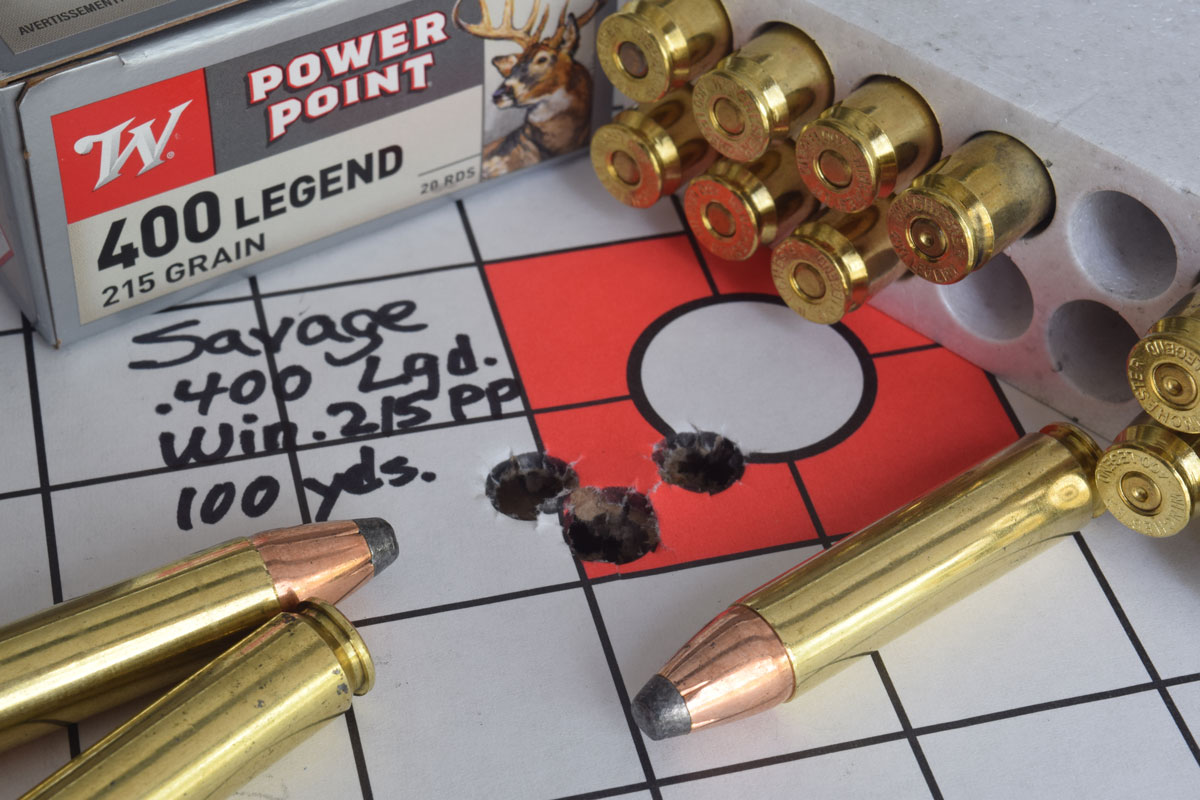
Wayne’s first deer tumbled to a Winchester Power-Point, an excellent bullet for the new 400 Legend.
Hunters became aware of polymer-nosed bullets after 1968, when Robert Hutton wrote that CIL was making its Dominion centerfire ammunition in Plattsburg, New York. Soon, deer were falling to those Sabretip bullets (under the Imperial brand). Norma was experimenting with polymer noses about then, but its Plastic Point was rounded, not pointed. Better polymers, and the machinery to make them, followed. Poly-tips didn’t take off, however, until after the debut of Nosler’s Ballistic Tip in 1984. Essentially this was Nosler’s impact-extruded Solid Base bullet (circa 1972) with a new nose. Polymer tips have sold so well since that they’re now added to bullets quite capable without them!
While sharp, colorful tips catch the eye, a bullet’s ogive and length figure more heavily in its arc. And its heel has much to do with its accuracy. The design of the tip’s unseen peg and the cavity securing it matter too; they affect not only concentricity but upset.
Incidentally, the Hornady crew tells me flat-base bullets are just as accurate as those with tapered heels. In fact, they can be more accurate, as heel taper adds another angle—a variable—to get just right.
Long, sleek bullets retain their velocity well as they fight drag and gravity. But over normal shot distances bullet velocity can be overrated.
Early 30-30 Win. loads didn’t reach 2,000 fps; but countless bucks have fallen to 170-grain round nose bullets moving much slower than that at impact. Velocity and weight do offset each other; 95-grain .243-inch bullets get most of their zip from Mach 3 launch.
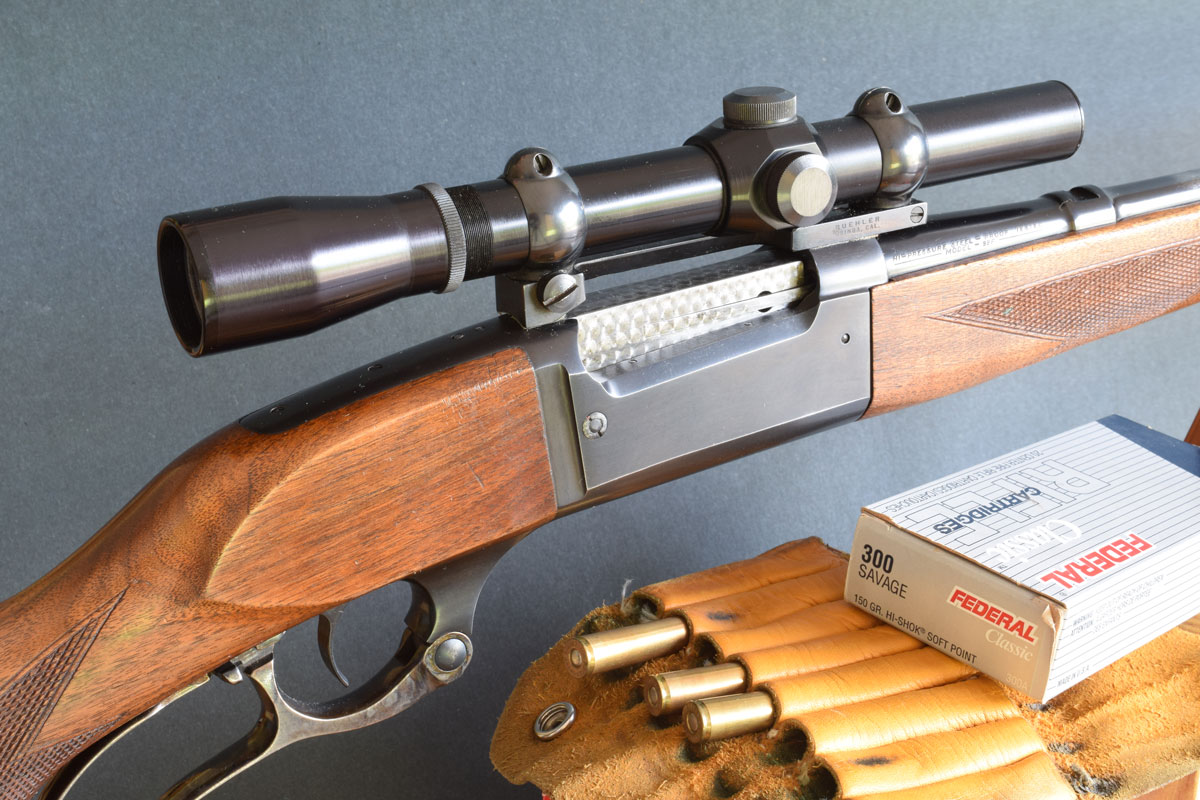
Federal Hi-Shok soft points for classic deer rifles such as this Savage Model 99 gave way to similar Power-Shoks.
So-called “controlled expansion” bullets may not be ideal for deer hunting. Indeed, the upset of all bullets built to expand is controlled by their design, impact velocities and target resistance. “Brakes” on mushrooming—core-jacket bonds, thick heel jackets, dual-core design and mid-shank dams per Nosler Partitions and Swift A-Frames—help retain weight and shape for deep penetration. Lead-free bullets such as Barnes’s Triple-Shock hollowpoints also poke long channels. But deer are relatively fragile, and ordinary soft points from traditional deer loads reach vitals even with gently quartering shots. Disintegration upon impact and failure to upset are now rare among lead-core bullets designed for and used on deer-size game.
About BC …
Long pointed bullets with gradual ogives (Pinocchio noses) have high ballistic coefficients. These numbers tell how well bullets fight drag. Every BC benefits from high sectional density (ratio of a bullet’s weight in pounds to the square of its diameter in inches). A pointed nose slips through air better than does a blunt nose. But a long pointed bullet adds weight without adding frontal resistance, so is more efficient than a stubby one. BCs of modern bullets are listed as G1 and G7. The G1 “standard bullet” dates back a century and is not very sleek so, in comparisons, bullets have higher G1 numbers than when matched to a sleeker G7 standard.
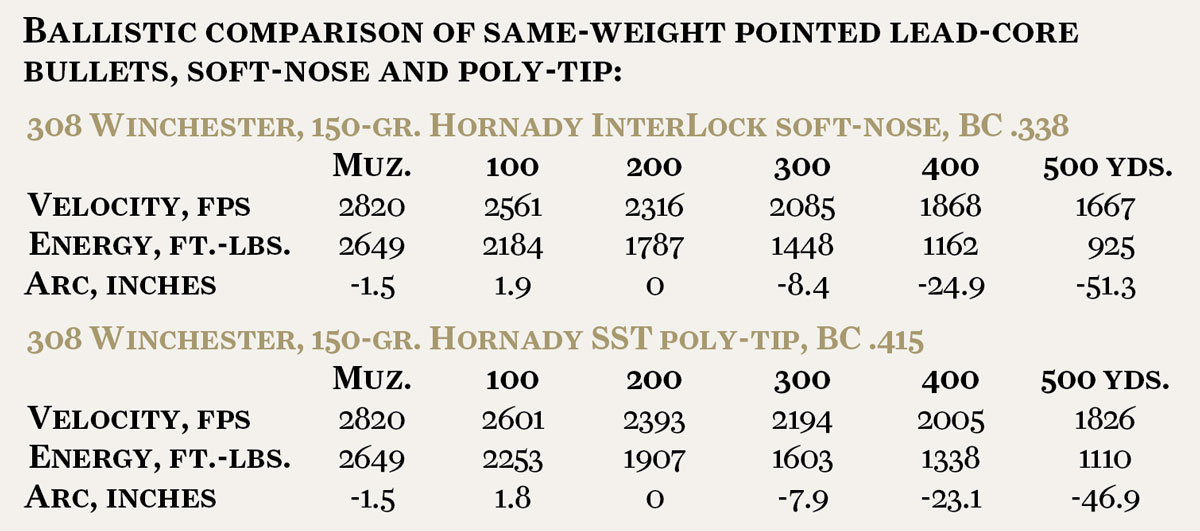
The flatter flight and increased velocity and energy retention of high-BC bullets show up at long range. As this comparison shows, there’s less to be gained by a hike in BC at normal deer-killing ranges:
At 300 yards, these two bullets land half a vertical inch apart, despite a speed disparity of 109 fps. At 400 yards, the gap is less than 2 inches, as close as most hunters can hold from sandbags. There each bullet delivers a half-ton blow, a harder hit than needed to expand a bullet or kill a deer.
While high-BC bullets also buck wind better than less streamlined bullets, their liabilities are worth noting. Recoil is often stiffer than from lighter missiles sent faster. Also, pursuit of ever-higher BCs has yielded bullets so long that they beg sharper-than-standard rifling. Any given twist rate works within a range of bullet lengths, not weights. Comparing the lengths of 85-grain .257-inch Nosler Ballistic Tips to those of 100-grain .257-inch Speers, I found the Ballistic Tips, with their tapered heels and sleek noses, are longer than the heavier Speers. And Ballistic Tips are not, by most standards, in the high-BC camp!
Few hunters will get an edge from bullets with BCs of more than .600. Or .500. Or even .400. Nor will a bullet bringing a ton of smash at 250 yards kill deer deader than dead. The most effective loads encourage practice that improves shooting. Neither price nor recoil should make you flinch.
What if a long shot is your only option? In 1984, Jeff Mekelburg first saw the whitetail that would elude him and other hunters for two frustrating seasons. But tracks in fresh snow on the 1986 opener pulled Jeff across prairie until, far off, he spied the great non-typical rack. With no cover for an approach, he put the thought of firing out of mind and forced himself to withdraw. Later, he found that deer again, this time where he could trim the range. A 200-yard shot with his 7×57 dropped the buck, a new Colorado record!
The best bullet, Mekelburg knew, is the one sent between a deer’s shoulders.