
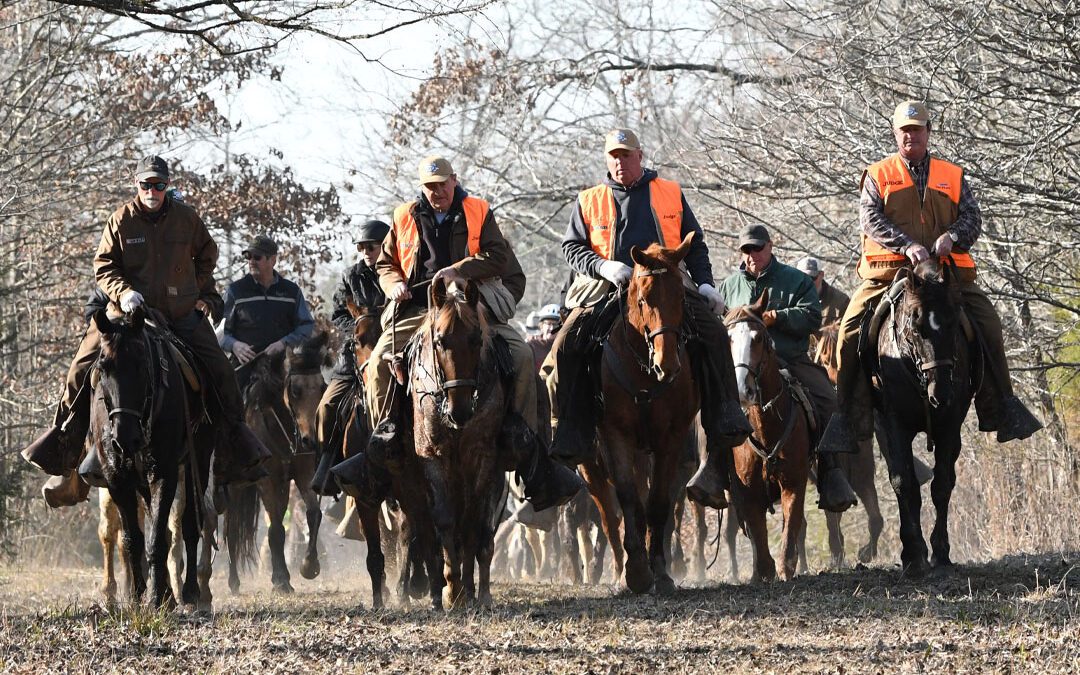
In 45 American states, January is the coldest month of the year. Frigid temperatures are challenging enough, but ladder in precipitation and you have a recipe for disaster. Wet, gnarly conditions knock down trees and limbs causing power outages and, if you’re in quail country, then that weather first knocks warm weather grasses to the ground before coating it with frozen water that turns it into a skating rink. That kind of living is hard on Gentleman Bob, and such weather repeated year after year results in fewer whistles in the fields. Biologists must have been thinking about this time of year when they said that the bird’s call sounds like “poor Bob White, poor Bob White!” for indeed they do.
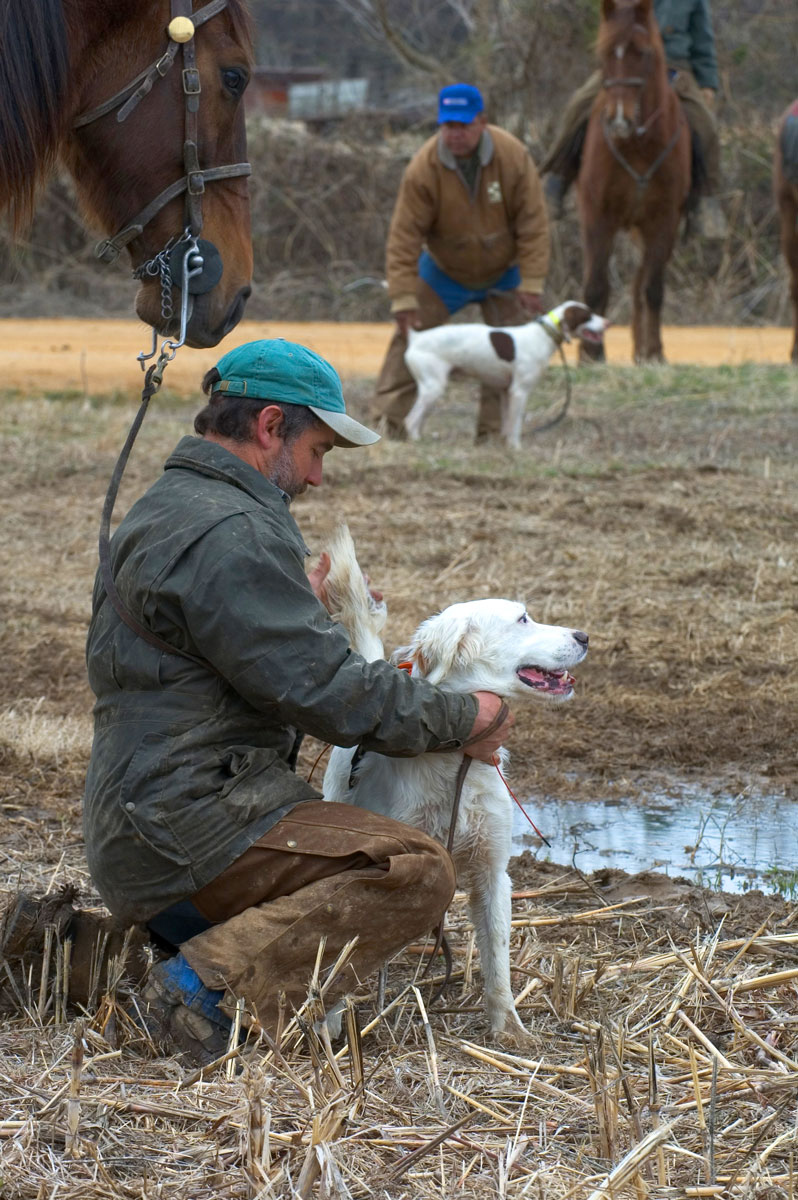
Bobby Kirk handles his setter, Cane Creek Brutus, on the morning course at Ames Plantation, while Fred Corder handles his pointer, Game Maker. Photo: Chris Mathan
Over the years, that’s exactly what happened in the quail fields at Ames Plantation in Grand Junction, Tennessee. But these aren’t just any fields, mind you, they are the ones used in the running of the field trial’s Super Bowl, the National Championship for Bird Dogs. Ames Plantation was founded as a hunting preserve, a livestock operation and a cotton plantation in 1901 by Hobart Ames, a wealthy industrialist from North Easton, Massachusetts, who was the successor to the Ames Shovel Company that was founded in the 1770s. Ames’ vision and habitat management created an expansive plantation so flush with huge coveys of wild bobwhite quail that the event that was first organized and run in 1896 near West Point, Mississippi, moved to Grand Junction in 1915. The National has been held at Ames ever since.
Part of what made Ames such a perfect choice for the National were the innovative farming practices that resulted in the consistent creation of early successional habitat. Ames imported Angus cattle from Aberdeen, Scotland, and their grazing was regenerative to the land. He raised row crops in the best soil, grazed cattle in lessor soil, and rotated the fields to improve overall soil health. Soybeans, cotton and sorghum were planted for market, and wheat was planted to benefit the quail. And for a long time, his vision worked.
Yet, the modernization that came with time, along with other environmental changes, have caused bobwhite quail populations in the South to decline since their heyday in the 1980s. Ames Plantation’s quail coveys were safeguarded for a time slightly longer than that, but even those numbers consistently dropped.
In September 1999, bobwhite density on the morning field trial course was estimated to be one quail per 1.54 acres. Survival between mid-September and mid-December in that year showed a 57 percent survival rate. Four out of every 10 birds died, dropping the number of quail per acre to one bird for every 2.7 acres. Fifty-two percent of the 5,000-acre field trial course was closed canopy hardwoods and little herbaceous and shrubby groundcover, the kind that comes when sunlight reaches the ground.
The quick solution? Supplement wild birds with those raised in captivity. A greater problem came from the fact that birds that hop or don’t fly well in wet, soggy conditions don’t cut it for the best bird dogs in the nation; pen-reared quail can have a significant negative affect to wild, resident birds including poor recruitment.
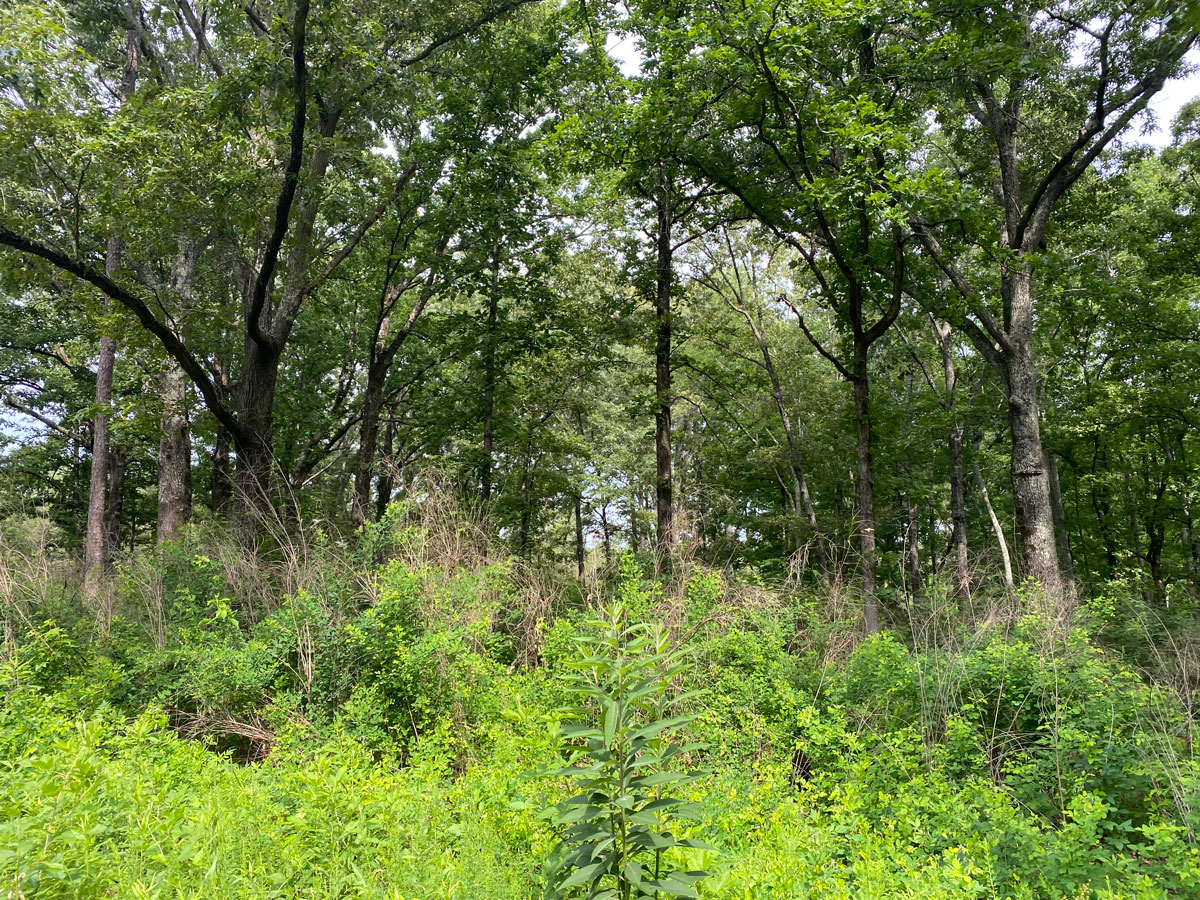
Thick tree canopies block sunlight and create landscapes uninhabitable by bobwhite quail.
Things looked grim for the Mudville 9, but due to an innovative new partnership between Ames Plantation and the Tallahassee-headquartered Tall Timbers Research Station, Casey didn’t strike out at bat. According to Matt Backus, the director of the Ames AgResearch and Education Center, “an over-simplification of our goals is that we’d like to run the National Championship on wild birds during the day and then have a cocktail on the manor house porch after the running and listen to the whistling birds as they covey up for the night.
“Transitioning from raised-in-captivity birds with a self-sustaining, wild population is a lofty goal, but we believe that it’s important to the Ames legacy. Following Hobart Ames’ passing in 1945, his widow, Mrs. Julia Colony Ames, wanted to memorialize her late husband’s name. She created a perpetual entity that allows the Plantation to continue operating under the ownership of a Trustees of the Foundation, and that it would benefit The University of Tennessee.
“Ames Plantation represents a total of 18,000 acres. Her bequeath to UT was that 12,000 acres would be used for continuing the world-renowned Angus herd, and to research and support row crop planting and raising as well as forestry and wildlife programs. The additional 6,000 acres, along with administrative support, were to be used for all facets of running the National Championship. As a result, we’re very excited to work with Tall Timbers on this restorative project.”
Since 1958, Tall Timbers Research Station has been a leader in land stewardship through research, conservation and education. Alex Jackson, Tall Timbers’ quail expansion biologist, will work with Backus to bring the partnership to life. Certainly, Jackson’s interest in Ames Plantation is one of passion, but it’s in his DNA.
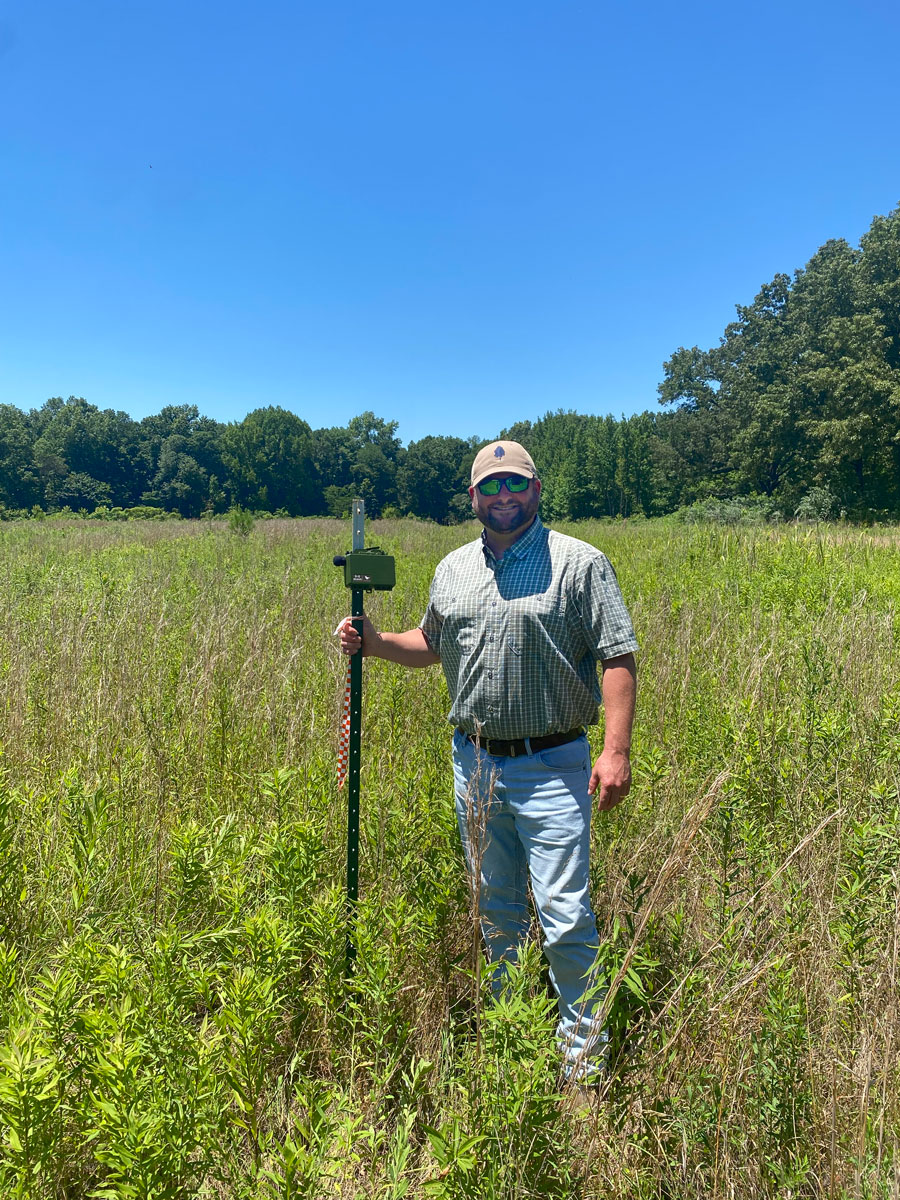
Alex Jackson’s passion for quail restoration at Ames Plantation is part of his DNA.
“I grew up in Germantown, a 45-minute drive from Ames and have a family farm 10 minutes down the road,” he said. “Working here is sort of a homecoming for me. Our initial scope of work is for five years, and our science and management teams are hard at work. Historically, much of our work has been in the Red Hills and Albany regions of southern Georgia/northern Florida, and traditional regional programs in Texas, Alabama, central Florida and the Carolinas. The Chuck and Martha Ribelin Quail Expansion Program, which was established in 2023, is enabling us to move into new areas within the bobwhite range.
“Currently, we’re developing an overall bobwhite management plan for Ames in conjunction with our partners, which includes the Tennessee Wildlife Resources Agency (TWRA) and the University of Tennessee. We’ll conduct overstory tree removal and thinning as necessary, so we have a less than 50-percent overstory canopy within the quail focal area. Prescribed fire, disking, herbicide applications, predator control, among other habitat initiatives, are essential starting points.
“We will use radio telemetry to monitor the demographics of the bobwhite quail, which includes adult and nest survival as well as their habitat selection, which will provide essential information for future work. Spring whistle counts and fall covey counts are two other methods that provide reliable information. There are many more deliverables, but this overview shows why everyone at Tall Timbers is excited about the project.”
Don’t tell me about the labor pains, just show me the baby. One of Tall Timbers’ many lofty goals is to have one quail per acre, a dramatic improvement over the 1999 numbers. But can they do it? A betting man says yes, with that answer being based on fact. In 2013, Tall Timbers was bequeathed the 9,100-acre Dixie Plantation, which has played host to the Continental Field Trial since 1937. In their first decade of habitat improvement, Tall Timbers has seen a 56-percent increase in wild bird populations—which is a whopping two birds per acre. Subsequently, Dixie has been renamed Livingston Place in honor of its owners, the late Gerald M. Livingston and his daughter, Geraldine.
The Ames Plantation and Tall Timbers Research Station’s relationship is such a recipe for success that their combined efforts remind me of a favorite quotation by the late Gene Hill. “I felt strange and somewhat rude as I walked in behind the point and honor—I was a man walking into what was so much like a famous painting that I almost had to laugh. But, if you’re lucky, that’s what a lot of quail hunting is—a series of lovely paintings that we walk into and out of all day long.”
And what, pray tell, is wrong with that?