
Still in the dark about night vision and thermal sights and gobbledegook thereof? To enlighten…
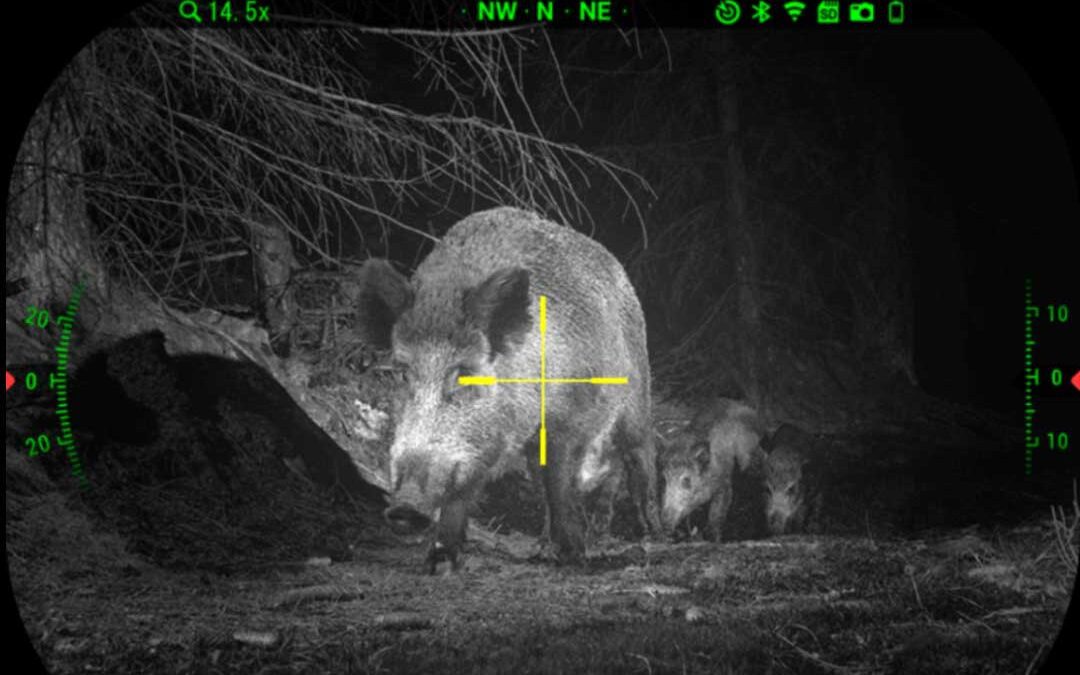
The feral pig appeared with the first stars. I was already hiking to the car. A quick sit steadied the rifle; but the reticle vanished in night’s shadows and the boar merged with a stump. I didn’t risk crippling the animal. A night vision or thermal imaging sight would have handed me the shot.
A standard riflescope helps you aim mainly because it brings the reticle and the target onto one plane. It adds precision as it magnifies the target, whose image appears brighter as the lenses funnel light in a “bundle” to your eye. The packaging of light by the scope’s exit pupil (the diameter of that bundle) and field of view can give you the perception of a crisper image. (Doubt this? Spray-paint the inside of an empty paper towel tube a dull black and peer through it).
In some texts, night vision (NV) scopes include thermal imaging sights as a sub-set. But the two differ. NV devices “intensify” light available from the moon, the stars and other sources. Typically, infra-red (IR) and visible light are combined in an image intensifier that coaxes a bright picture from relatively few photons of input. A vacuum or photomultiplier tube helps in this transformation. Active illumination that supplies IR light (700 to 1,000 nanometers, just over the visible spectrum) delivers a monochromatic image with good resolution.
Thermal sights function independent of light by sifting temperature differences between the target and its surroundings. A thermal sensor, usually vanadium oxide, converts heat to a visible image. Thermal sights bring animal targets into bright relief on the darkest of nights and, within limits, through fog, rain and smoke. Solid objects (rocks, trees) effectively block the heat of bodies behind them. Glass and acrylics have their own thermal signatures and are opaque to long-wave IR radiation. The greater the temperature disparity between the target and its environment, (a coyote on a snowy hill), the more distinct the target and the greater the sight’s effective reach. While NV scopes transmit some natural color, thermal sights do not. Thermal images can be manipulated by adding color with the sight to enhance visibility—even, to a limited extent, resolution. “White-hot,” a popular choice, shows targets bright white against backgrounds in shades of black.
Unlike traditional riflescopes, thermal sights won’t outlast your grandchildren. Figure 40,000 to 60,000 hours of use. The OLED or AMOLED display on a thermal sight survives “in round figures, about 10 years,” according to people who make them. Double that life for Germanium objective lenses. As with an NV scope, the aluminum, magnesium or high-grade polymer shell is the most durable part of a thermal sight. Caveats when using both types of sights: limit exposure to heat, dust and moisture.
Many electronic sights are compatible via smartphone app with video-sharing devices. Files are transferred by Wi-Fi connection. Video clips can be uploaded directly onto a website or stored on an SD card for later viewing.
Rechargeable lithium-ion batteries are the best engines for powering NV and thermal sights. Life per charge varies with the sight and the setting you use. Figure eight to 14 hours, with cold weather reducing that time. Charging some batteries can take nearly half as long as the life of the charge. It’s best not to fully deplete batteries. InfiRay sights have onboard rechargeable batteries that automatically take over when removable batteries are depleted, so you don’t miss a shot or a video.
Which more effectively helps you spot game at night—NV scope or thermal sight? That depends on how much ambient light there is, weather conditions and temperature differences between target and background. Commonly, a thermal sight is best at detecting animals, especially in inclement weather. The NV scope excels for identifying (seeing detail in) targets. Resolution for both devices is given in pixels, such as 1280×720. The higher the numbers, the greater the resolution. Displays on thermal sights typically offer higher resolution than their sensors.
The practical reach of NV and thermal sights depends not just on conditions but on the quality of the optic. A top-drawer thermal scope might detect a coyote at 4,000 yards—twice as far as easily visible with less costly thermal sights and NV scopes. At any given level of quality, thermal sights cost quite a bit more than NV scopes.
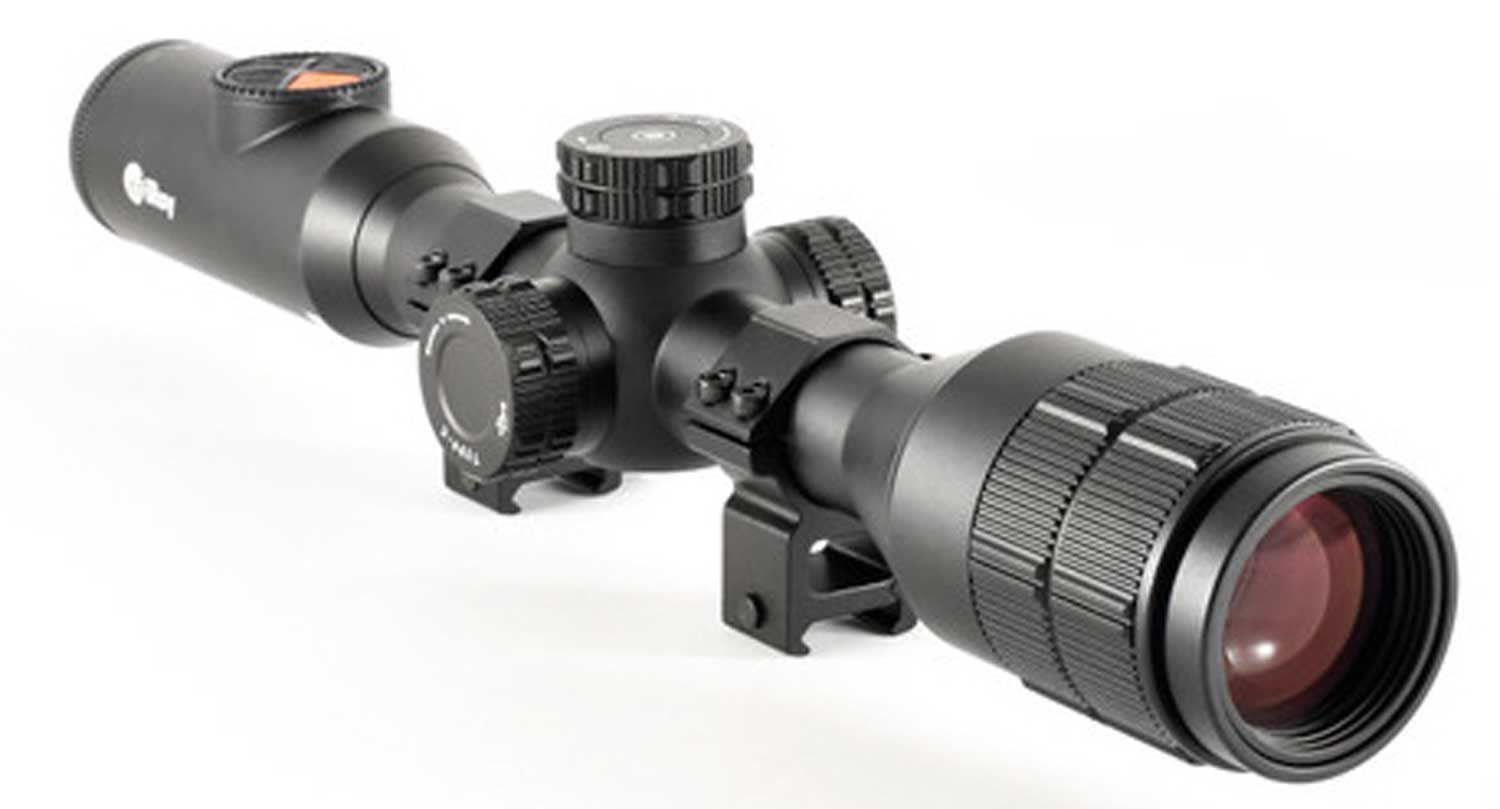
An iRayTD50L night-vision sight intensifies visible and IR light of few photons to bring bright images.
Among an increasing number of companies helping you aim at night, IRay Technology Co., Ltd., founded in 2009, has established itself as a leader. Products branded InfiRay Outdoor are distributed and warranteed by iRayUSA in Texas—which boasts a five-day turn-around time for repairs or replacements of its InfiRay sights. The company’s Bolt series of NV and thermal sights share the profile of ordinary riflescopes, with 30mm tubes and common mounting options.
The Bolt TD 50L is a 4×50 NV scope with 1440×1080 resolution. It boasts three image modes: daytime (for true colors) and two for more limited lighting. You get 600-meter reach in night-time mode. Choose from two optional IR illuminators. An internal 6600 battery augments a replaceable, rechargeable 18500 battery with 13-hour run-time. Smooth 4-16x zoom, 16 GB of memory and built-in Wi-Fi module make the Bolt TD 50L a must-see for hunters. Waterproof and dust-proof to a top “IP67” rating, this 33-ounce NV scope retails for $1,499. That’s $500 less than a Bolt TL 35 V2 Thermal Sight with 384×288 sensor resolution.
The InfiRay thermal sight getting most attention now is the Bolt TH50C V2. Consistent with its sleek profile, this sight’s 2560×2560 circular display delivers a look much like that of an ordinary 4x riflescope. Resolution from its 12-micron Micro II core processor is 640×512—very sharp. An “Ultra-clear” mode brings even better definition to the target. It has long reach, too: 2,600 meters by the manufacturer’s measure. Like the TD 50L, the TH50C V2 has a replaceable battery and an onboard rechargeable battery. This 32-ounce 2.5-10x sight offers seven reticle choices, each with white-hot, black-hot and red-hot color options. The 30mm 6061T aluminum tube won’t fail. An optional Bluetooth-friendly laser rangefinder adds utility.
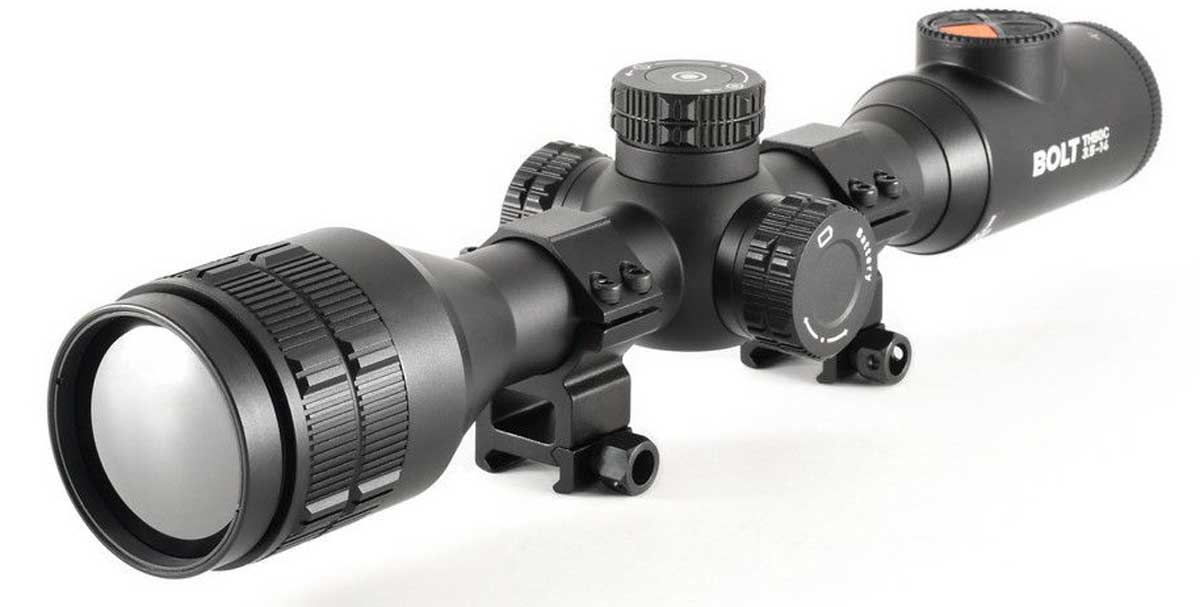
Like many hunters who grew up with manual chokes and window cranks in automobiles, I’ve a long-standing aversion to the unintuitive. Teeny buttons and switches interspersed with undecipherable icons give me the vapors. While the Bolt TH50C V2 is hardly as basic as a Weaver K4, it’s been praised for its intuitive controls. From “on” to “standby” to zooming, focusing and shooting video, it’s designed for no-look use. Its IP67 rating weathers field conditions. Zeroing is as easy as with ordinary scopes and, with 32 GB of memory, the Bolt TH50C V2 can hold almost a Disney chest of video and still images. The InfiRay Outdoor Bolt TH50C retails for just under $6,000; discounts have brought it shy of $5,500.
ATN also makes NV and thermal sights—besides traditional riflescopes that impress me for their optical quality. A pioneer in digital NV binoculars, ATN is one of the world’s most active buyers of image intensifier tubes. It sources components from a range of suppliers to get the best titanium and aluminum alloys and polymers. It installs windage and elevation adjustments as fine as 1/8 minute. Thermal core sensors of 160×120 to 649×480 serve military and industrial applications as well as sights for sporting rifles. An ATN scope once kept me hunting in a blizzard of wet snow and delivered a spot-on kill at 300 yards through trailing fog. A long roster of ATN optics, many selling for less than $1,000, includes ThOR 4 and ThOR 5 thermal sights. The versatile ThOR 4 384 2-8x has been discounted to $1,999.
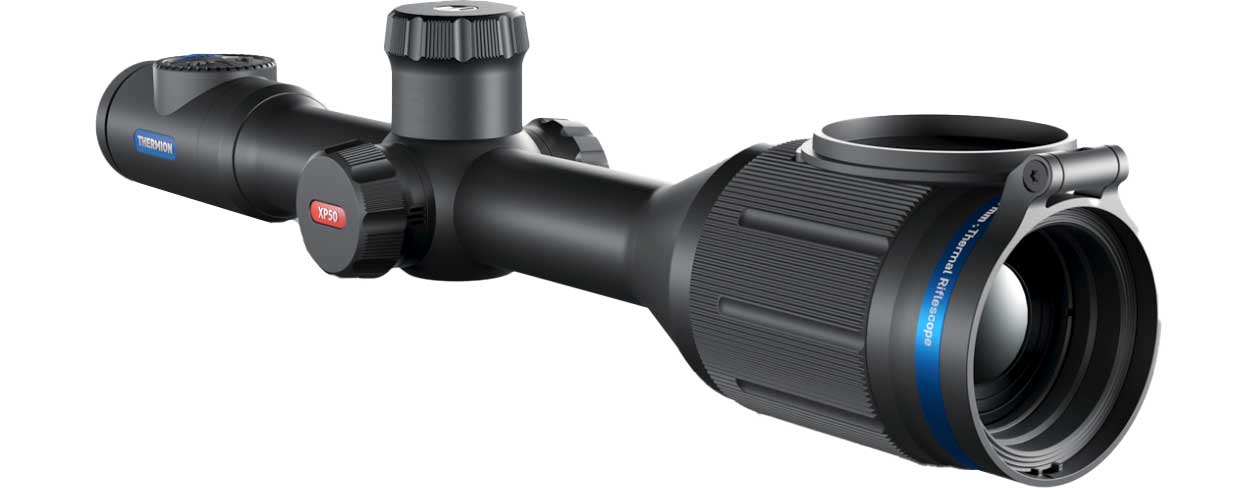
Pulsar’s line of NV and thermal sights includes the Thermion 2 XG50. This 30mm sight has a 1024×768 display and an optional laser rangefinder. Its 640×480 sensor delivers useful resolution to its 2,300-meter range. Select from three sensor sensitivity levels, 10 reticles and eight color palettes. The Thermion 2 XG50 lists at $4,000.
Another prominent name in NV and thermal sights is Sightmark. Its lightweight (19-oz.) Wraith 2-16×35 thermal sight has a 1024×768 display and a 384×288 sensor. It comes with a 10-hour battery and a self-mount that snugs to a Picatinny rail. Pick from 10 reticles in nine colors. This compact Sightmark is rated to detect heat signatures to 1,400 meters and lists for about $1,500. I like this sight. It’s affordable, practical and won’t weigh you down as you trudge between coyote sets!
There also are NV and thermal units designed as accessories to the scope already on your rifle. The Pulsar Forward F455S is a digital NV device with 1280×720 resolution and a 500-meter reach with its IR illuminator attachment. Housed in lightweight magnesium alloy, it’s built to tolerate the recoil of a 375 H&H rifle or a 12-gauge shotgun. Burris has the sleek BTC35 V3, a thermal unit that can be clipped to a standard scope’s front bell or used, with digital zoom and supplied mount, by itself.
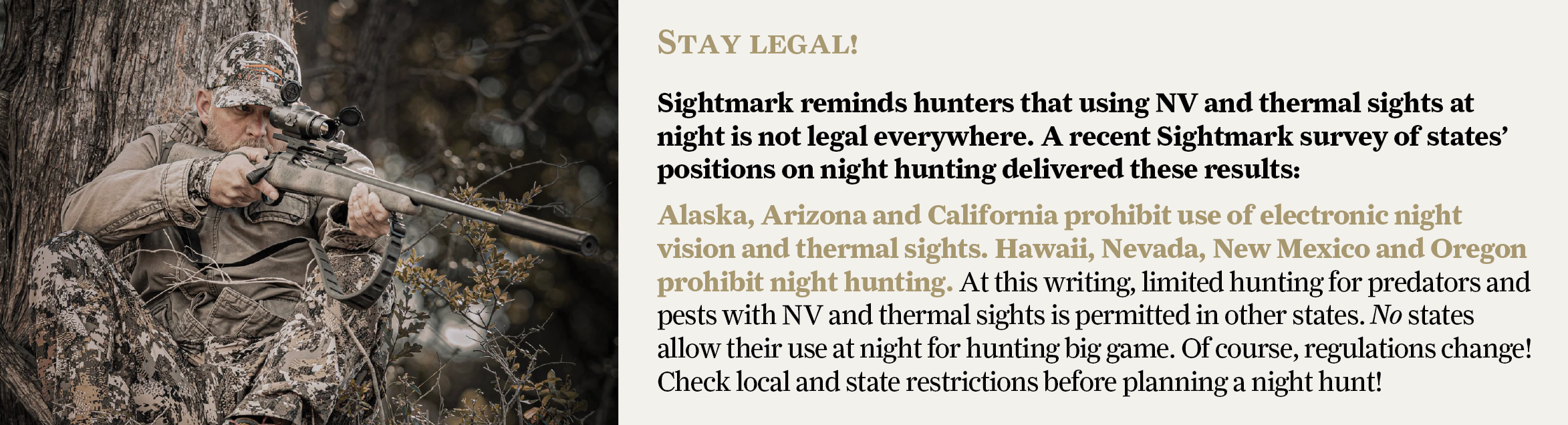
Plying the hills at night offers more than just a greater chance of finding predators afoot. After dark, animals move more boldly than during the day. Night vision brings them into view without sending them off. You’ll find creatures not on your hit list, from other nocturnal hunters to thick-antlered bucks and bulls that ghost from unknown places to disappear again before dawn. Image intensifiers and thermal sensors reveal what daylight erases. Whether or not you quarter a spectral beast with your reticle, the hunt is unlike anything you’ll experience after sunrise!
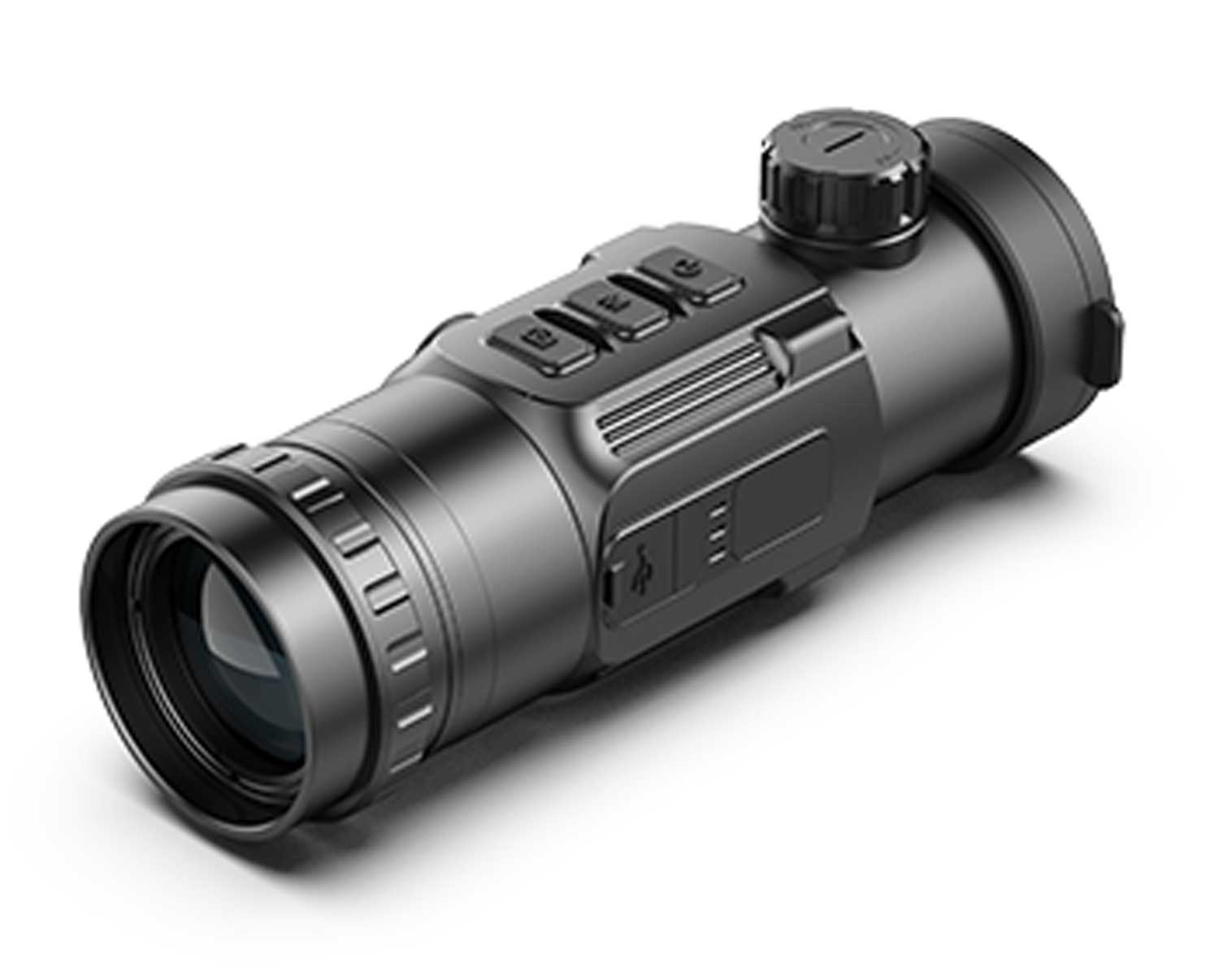
This clip-on CH-50 thermal unit by iRay is sleek of form; but its control buttons are big and easy to feel.
Sifting Night Sights
Before buying a night vision or thermal scope, study the specifications. That list is longer than for ordinary scopes. Besides numbers showing power range, objective diameter and windage and elevation graduations, you’ll find pixel counts for the display and thermal sensor, or the image intensifier. The greater the number of pixels, the higher the resolution. Pixel pitch (example: 12 microns) is different; the smaller the number the better the view. Mind battery life and re-charge times—also the instrument’s weight. Nearly all features that make electronic sights more capable add heft. Objective size affects weight too; you may not need as much glass or housing there as you might wish in an ordinary scope. Mounts also matter. Rings included with some electronic scopes have yet to impress me, and many are too high for natural aim with standard stocks. Especially at night, you’ll want that scope to come to eye naturally. Clip-on NV and thermal units need only fit your scope. But some have their own mount, to relieve the scope of the unit’s weight or so you can use the NV or thermal unit independently.
If spec sheets don’t tell you all you want to know about electronic sights, ask a salesclerk or send questions to the manufacturer online. Don’t fret about asking what geeks might think is a “stupid” question. The geeks aren’t spending the money or betting a hard-won shot on the optic. Satisfy yourself about video storage, refresh time, Bluetooth compatibility. If you don’t understand a spec, or if you wonder why one scope costs three times as much as another, ask! NV and thermal sights are investments. Questions from investors are expected!