
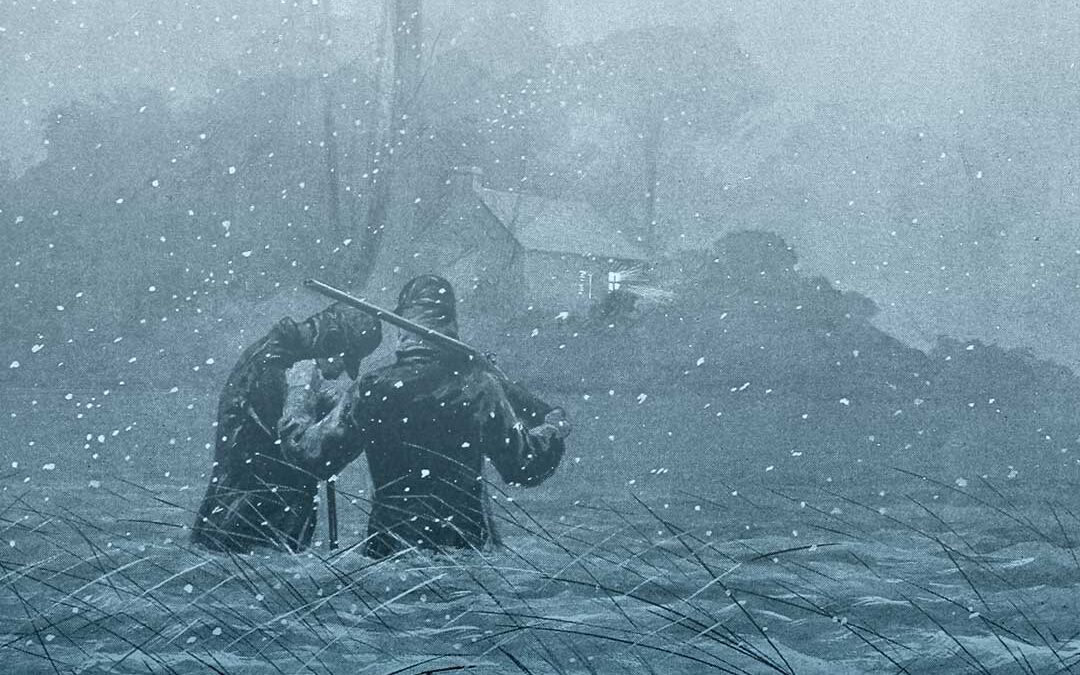
On Thanksgiving, a shoot at Hooper’s Island in Chesapeake Bay furnished some experiences that will not soon be forgotten. Our party consisted of three—my hosts, Bert and his brother Al, and myself. With me went my two dogs, Don, an English setter, and Nick, a pointer, both useful workers.
The first stage of our trip was by steamer down the bay; it proved pleasant, although uneventful. Then followed a 15-mile stage by wagon, and eventually we reached the ground.
After supper we gathered ’round the fire and lit our pipes. Outside the wind was howling, but we felt very comfortable. In due time we undressed and rolled up early in our blankets….
We were soon in bed for the night and asleep but were awake before sun-up and, after a hurried breakfast, started in the sailboat.
Al and I were in the bow with our guns, Bert was steering…. We had a fair day’s sport, and about four o’clock we reached the house. After supper we loaded some shells, and then turned in.
Next morning, bright and early, we took the dogs and started after partridges, and by night had 20 birds to show for our day’s bag. The next two days it snowed very hard, and we were obliged to keep indoors, but Thanksgiving Day dawned clear and bright.
We put Bert in the sink boat, and Al and I sailed around after ducks. We got 10, and Bert got five geese and two ducks. The next few days were spent in the sailboat. Then came a clear, cold day, and Bert and I took guns and decoys, and rowed out to the marshes, one and a half miles from shore. We set out the decoys and got in a blind where we stayed all day, getting six geese and 14 ducks.
At about five o’clock we began to get hungry. The sun had gone down, and we decided to start for home, but on launching the boat we found that on account of the strong north wind that had blown all day, the ebb-tide was extraordinarily low, so much so in fact that there was not more than two or three inches of water near the marsh, and consequently the boat stuck fast in the mud.
We got overboard, thinking we could drag the boat to deeper water, but she stuck fast on a bar and in trying to get her off we broke both oars. Well, to put it mildly, we were in for it. One and one-half miles from shore and with no probability of a high tide before morning; our clothing was wet and freezing, we were tired and hungry, and to cap the climax, it had gotten dark.
We returned to the marsh and tried to build a fire, but we found it impossible as all the wood was wet, and we had to give it up. Knowing very well that without a fire we’d soon be frozen to death, we decided that our only hope lay in reaching the shore, from which we were separated by one and one-half miles of angry water. And although it was shallow near the marsh, we knew not how deep it was between us and home.
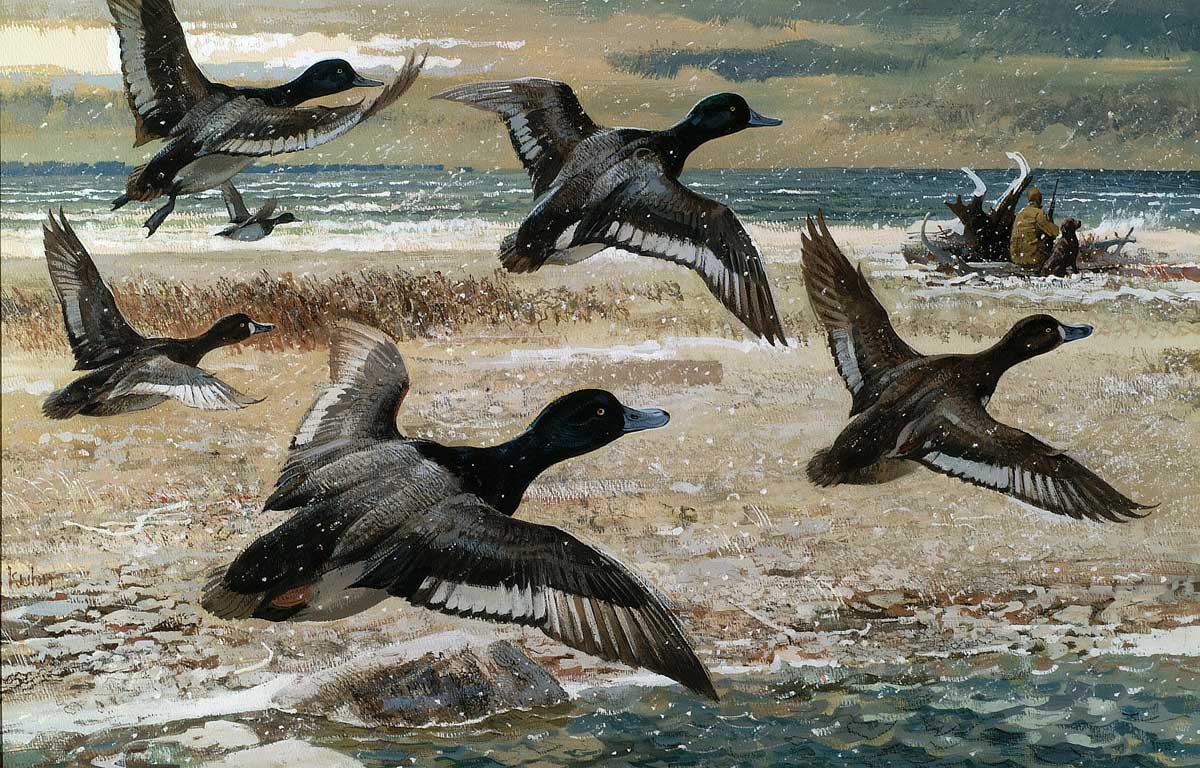
Bluebills in Snowstorm by Bob Kuhn
We had on very heavy clothing, overcoats, boots, cartridge belts and the guns, two 12-gauges and a big 8-gauge. At first, the water was shallow and the bottom firm, and we made good progress. After we had gone about one-half mile, the water getting deeper and the bottom softer, we stopped to rest, but found to our dismay that if we stood still our feet sank deeper and deeper into the mud; so we pushed on, trying to laugh and joke, although we knew it was a fight for our lives.
The wind was blowing very strong against us, we were up to our waists in water, the waves would dash over us nearly sweeping us off our feet and our clothing was stiff and frozen. The wind cut my face like a knife. An unusually large wave struck me, I nearly lost my footing and in another moment would have fallen, but Bert caught me and steadied me, saying, “ Bill, don’t fall for heaven’s sake, or you’ll never be able to get up again.”
I dropped the stocks of my guns on the bottom and thus tried to get a little rest. It seemed hard to die out there in the cold and dark. Life seemed sweeter than ever before and well worth one more struggle, so dismissing all thoughts of the past and present I set my eyes on the light in the window of our house and thought only of reaching it.
We pushed on in silence, when suddenly Bert stopped, saying he was exhausted and for me to go on and leave him, which I declined to do. I caught hold of his arm and, telling him to think only of the light, we started once more and soon reached a blind that we knew to be 300 yards from shore. If it had been 20 yards farther off, we would not have had strength enough to reach it.
After a little rest, Bert held on to me while I fired 10 or 12 times, hoping someone would hear and come to our aid. Bert was yelling, “Help! Help! Help!” as loud as he could, but stopped long enough to say, “Bill, put the empty brass shells in your pocket; they cost ten cents apiece.” It made me feel like shooting him.
Bert wanted to hang on to the blind until help or morning came, but after firing all our cartridges and yelling ’til we were hoarse, and receiving no answer, we made a start for shore, preferring drowning, if we must die, to freezing.
By leaving the big gun and my overcoat at the blind, we were able to make headway. It began to snow, and at times the light on shore would be hidden, but just as we were about to give up all hope, the water became less deep and the bottom harder. Feeling sure now that we were near shore, our hopes returned and, on advancing we were rewarded by reaching the shore, which at this point was barely two feet high. We hadn’t strength enough to step up, but fell forward exhausted, thanking God for deliverance.
After several attempts I was able to get on my feet. I helped Bert to get up, and arm in arm we staggered to the house. We had been in the water four hours and our tired muscles could not stand the strain, for we just managed to get in the door when I fainted. When I regained consciousness, Al was rubbing me with mustard. I was blue from my waist down and Bert was still unconscious.
I helped Al and soon we brought Bert to. Then Al gave us each several cups of boiling hot coffee. After that he gave us nearly a pint of Jamaica ginger. Then we ate supper, and before retiring we took some quinine pills. Next morning we felt none the worse for our adventure, but after a consultation we decided we had had enough goose shooting for one year, and packing our things we hurried to the wharf, reaching there just in time to catch the boat for Baltimore.
This article originally appeared in the November 1898 issue of Outing.