
Thanksgiving Eve at length came around and I was off for Norfolk with the lightest of hearts and the gayest smile I had worn for many days. My friend and companion in arms, Mr. Parkins, met me there, and away we went together, as jolly a pair as could be found in a day’s travel. The trip was enlivened with many a story and good cigar and, now that we were fairly under way, the time passed quickly enough and before many hours had gone, we found ourselves nearing the point where our host was to meet and conduct us up the mountains. My companion was a man of 45 years and, being much given to the good things of this life had, in consequence thereof, acquired a considerable obesity—in fact more than most men could conveniently carry around. But Nature had given him a good pair of legs, and he knew how to use them, too.
When we reached our station and stepped upon the platform, loaded with baggage and firearms, a long, lank individual came up and, greeting my friend cordially, relieved us of the best part of our luggage, which he placed in a wagon nearby, then returned to shake hands and be introduced to me. His name was Mark Aaronson. He had lived in that country, he informed us, “for nigh on to sixty years, man and boy;” had taken many such a party on a hunt beforehand; was very glad Mr. Parkins had asked me to come, for he thought we would meet with luck, as he had seen a good many bear sign lately and the weather was favorable.
“Ever been bear shootin’?” he queried, looking at me out of his little gray eyes in a kind of half -suspicious manner as if he had not quite made up his mind to take me for a greenhorn or not.
“No,” I hastened to reply, but I have wanted to for some time.” Then there was a pause, and I felt a little awkward.
“I knowed that Mr. Parkins never had,” he continued, “but, hows’ever, it’ll be more fun than if you had, particular if you got to do any runnin’.”
“Do you have to do any running?” I asked, brightening up again at the prospect of chasing a bear.
“Well,” he said, “time’s been when a bear’s made me do a heap of it, but I’m getting’ too old now; I can’t run like I used to, but I’ll tell you there’s no knowin’ what a man can do when one of them things gets after him.” And with those words, the old man settled himself down on the front seat of the wagon and, cracking his whip, we were soon rolling toward the foothills of the mountains that could be seen in the distance.
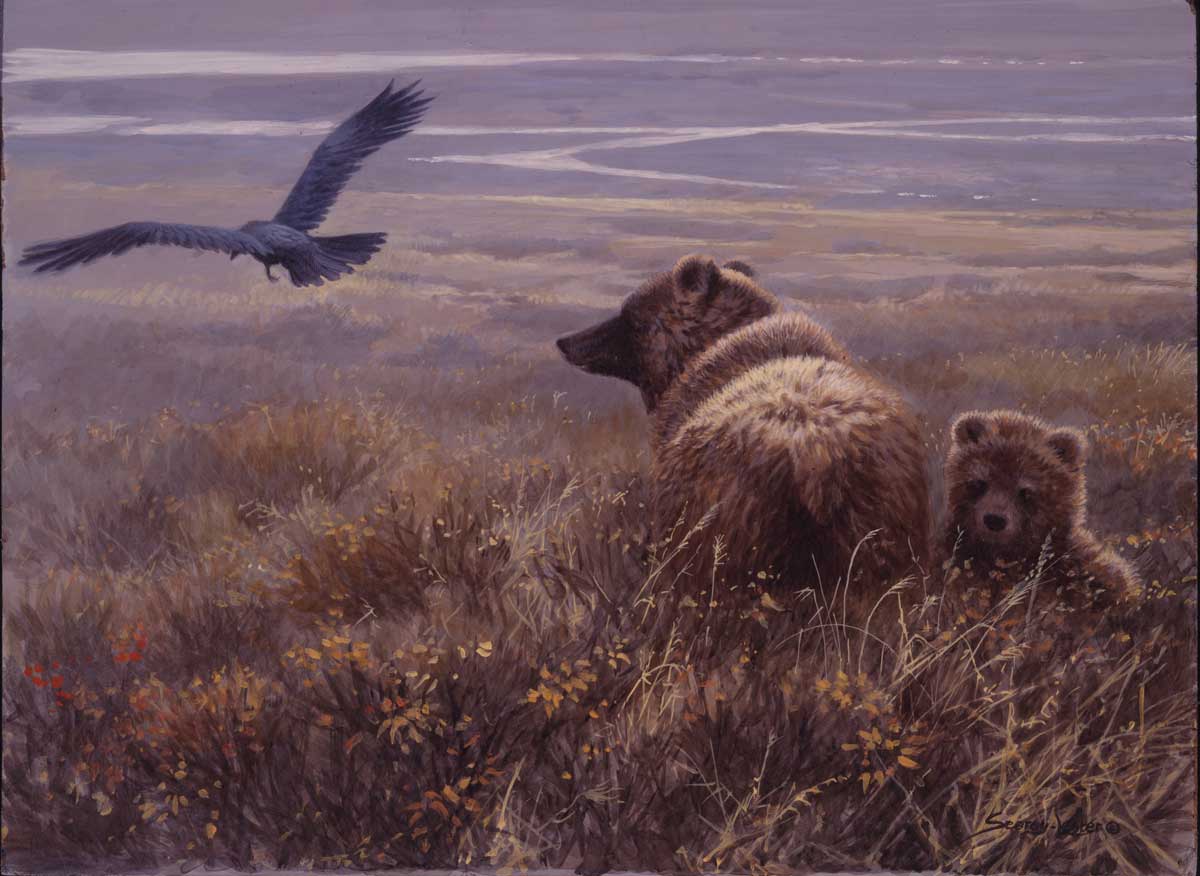
Grizzly Cub and Raven by John Seerey-Lester
An hour’s drive brought us to New River, after being ferried over which we gradually began the ascent of the mountains, and then for four long hours did we slowly toil up hill after hill until we were fain to get out and relieve the monotony of the ride by walking.
Just as the sun was sinking, the horses were pulled up at the door of our host’s cabin and we were there, thoroughly tired out with our travel and having great vacancies where our dinners ought to have been.
There was no face to greet us at the one little window of which the cabin boasted, and I was wondering how we were to get inside, when, to my astonishment, the old man climbed up a small tree and, dropping on to the roof, disappeared and in a moment his honest face was grinning at us from the door.
“It’s always fastened from the inside,” he explained, “and I have to go through the top. You see, I have to leave it for a week or two at a time when I’m off a- workin’, and it puzzles the tramps and such like to get in. There used to be a heap of them around after the war, but there ain’t so many now,” and running on in this wise the old man quickly unhitched the horses and fed them, brought all our traps in from the wagon, had a roaring fire going in the great open hearth and was busying himself with the preparation of our evening meal.
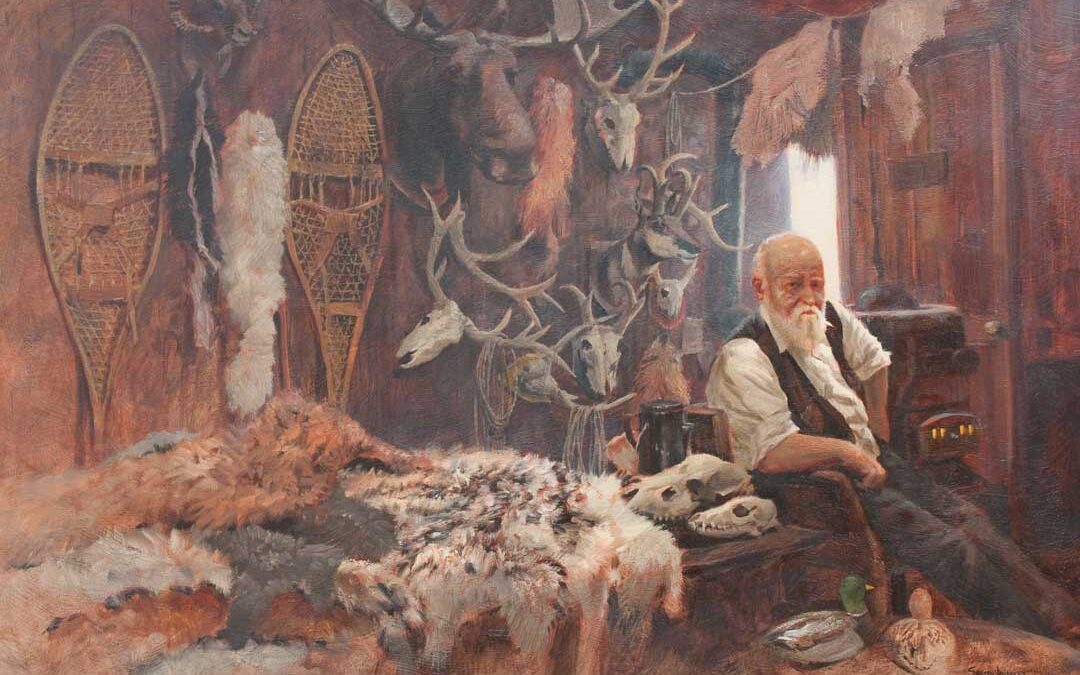
In the meantime, I had been looking around and surveying the interior of the cabin. It was a snug little place—very old—but having been well built of heavy logs, had stood firm against the storms of a quarter of a century and looked as if it were ready to stand as many more. It was decorated with several pairs of deer antlers, on one of which rested an old-time rifle. It appeared to be as long as our host himself and had evidently seen a good deal of hard usage in its time. Mr. Parkins, who had been examining it, too, now turned to our mutual friend with the inquiry: “Does it shoot straight?”
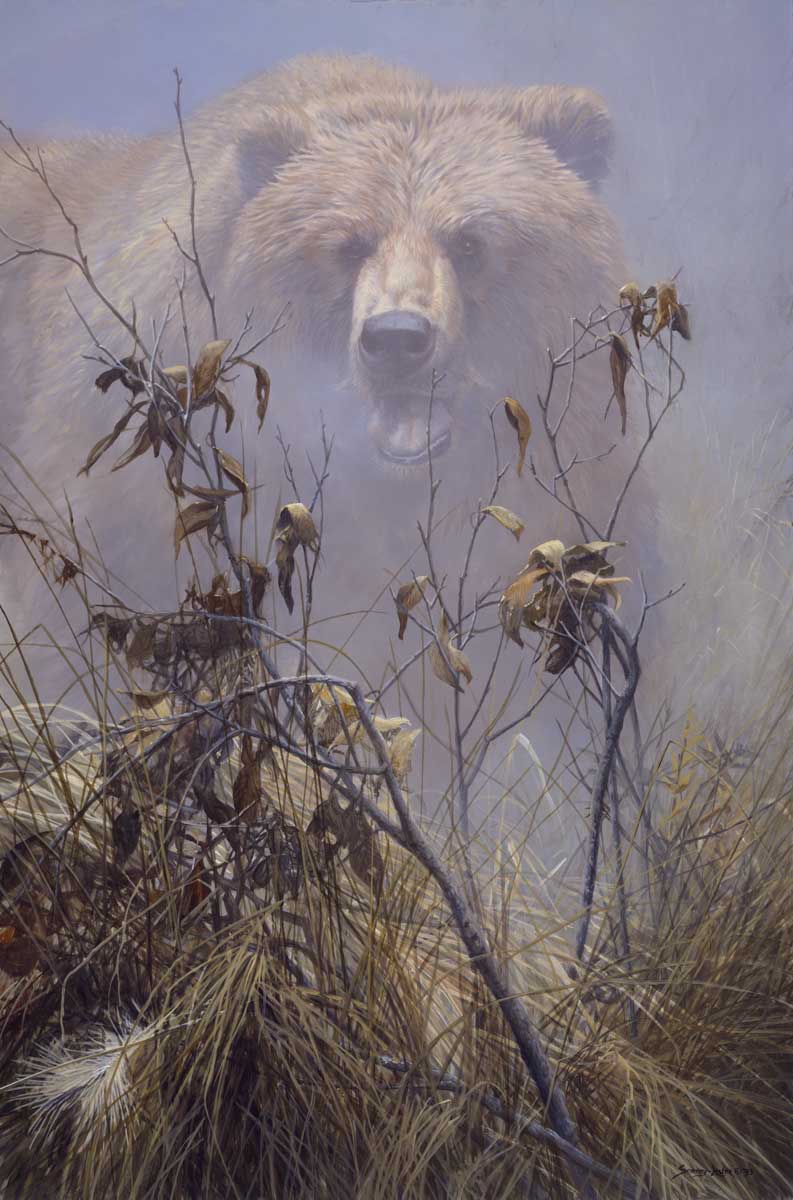
Grizzly Impact by John Seerey-Lester
The hunter looked up from the pan where he was frying bacon and, straightening himself to his full length, cast a loving glance at the old arm, and said, ‘’Well, it depends entirely on how you p’int it. If you p’int it straight, it’s agoin’ to shoot straight, and if you p’int it crooked, it’s agoin’ to shoot crooked.” We both said “ Of course,” in the same breath, and then I wondered within my secret soul how it would shoot if Parkins “p’inted” it and, if I am any judge of human nature, Parkins was wondering the same thing about me.
Some time before daylight our host aroused us, and in brief time we sallied forth—ready for anything. Our guide had secured the services of two drivers who owned 20 dogs between them. They were to meet us about five miles from the cabin where we were to consult as to the best territory to be driven then, dividing up, each man was to go to his allotted stand and there await developments.
This program being successfully carried out, I found myself about an hour after sunrise pacing up and down a little hill in the neighborhood of which all game must pass that was driven in my direction. We had three stands occupied and they were nearly in a line. This increased our chances for, if the first man missed, the animal would pass on to the second and third, giving everyone a shot.
I had been waiting on my stand nearly two hours—watching intently for “something to turn up,” when I heard the first yelping of the hounds opening on the trail and then they quickly strung out in hot chase. I was positive it was a deer, because they went so rapidly over the frozen ground. I listened with quickening pulse to the music of their 20 throats as it rose and fell and swept along the mountain side on that glorious day.
They came nearer and nearer; my heart beat rapidly. The first thing I did was to cock my gun and, I don’t know how it happened, but that plagued gun went off with a report that awoke all the echoes of the mountains and sent the hot blood rushing to my face. I was chagrined and deeply mortified. What would the hunter say and, what was more, what would Parkins say?
Every moment I expected to see the tall form of our host coming up to see what I had killed, and I was not disappointed— there he came, swinging along in his easy stride with his rifle slung over his shoulder, looking every inch of him the typical hunter that he was. As soon as he got within speaking distance he began with “Well, I heard you shoot, and as nothing came on down my way I suppose you killed him, whatever it was,” and I noticed his eyes running rapidly over the ground in evident search of the game I had not even seen. I began to blush, and then I managed to say my gun went off.
“Like as not,” said the hunter, “’cause I heard it way down the mountain side” I got redder and redder, but I said it went off before I got ready.
“You mean it went off before you saw anything to shoot at?” he inquired while an amused expression stole over his face. “Yes,” said I, “I was just getting ready to,” and then I explained how I had heard the dogs coming and had cocked my gun when off it went without rhyme or reason.
“You must of pulled the trigger unbeknowns,” he said. I hastily agreed with him and changed the subject. “We’d better be getting’ after your friend; time we get home and cook some dinner we’ll be hungry,” and he moved off at a good round pace in the direction of Mr. Parkins.
Ten minutes’ walk brought us there where we found him flat on his back—fast asleep. I looked at the hunter and the hunter looked at me.
“Well, durn my picture if he ain’t asleep,” said that worthy representative of Nimrod. “That’s the reason he never got to shoot at the deer; he must of run plum through the stand. I kept a wonderin’ why he hadn’t shot,” and saying that, he tossed a stick on to the stomach of my portly friend, who immediately jumped up and grabbed his rifle, but on seeing us he broke into a broad grin. He had been caught napping and there was no denying it. “I got tired standing up, and sat down on that log to rest, when the first thing I knew I was fast asleep.”
Our host, who had been searching the ground while Parkins was talking, now called us over to where he was standing and there were the tracks of the deer. He had passed within a few yards of the sleeping Parkins who, all unconscious of his presence, snored on in peaceful bliss. We wended our way home silently and sadly, for we were not in a humor to talk. I was put out with myself. Parkins with himself, and the hunter moralizing on the uncertainty of city folk.
Passing through the last strip of woods, just before reaching the house, Mark, who was in the lead, threw his gun rapidly to his shoulder and fired. Such a squawking as followed the report I have never heard. He had shot a wild turkey.
Several days later, we had killed only the one turkey and our host began to get impatient.
“I’ll tell you what, fellers,”—he had dropped the “Mr.” now, and we were hail fellows well met—“there’s a piece of timber up the country where I’m ’most certain we can start a bear. It’s a goodish walk to get there, but we won’t mind that if we can get to shoot something.’ Suppose we go up there in the mornin’ and try it?” We confessed our willingness to try anything; it would never do to return home empty-handed, so we agreed to make an early start and do our level best to bring back something in the shape of game.
We were off two hours before day, the dogs being so eager for the chase that the drivers had as much as they could do to keep them in leash before starting. “There’s a big, rocky gorge just below the timber,” said Mark. “I’m a goin’ to put you two fellers in there and then help the drivers. If there’s a bear in them woods he’s a comin’ out or my name’s not Mark Aaronson.”
At the first sign of day, we had reached the gorge in question and the hunter, placing us in a narrow, rocky part of it, volunteered a few parting words of advice.
“Now, fellers,” he said, “you can’t go to sleep on this here stand,” looking at Parkins. “And you mus’n’t shoot your gun off before you see anything,” with a glance in my direction. “A bear’s a bear, and when he gets a pack of dogs after him, why he’ll come through this place quicker ’n a yearlin’ heifer’ll go through a gate. You’ve got to watch yourself close. If you do see one a comin’ just cock your gun and take it cool like. Shoot him low down, right behind the foreleg. That’s where his heart is—low down, fellers.”
With these last words, spoken in a cheery voice, our guide threw his rifle into the hollow of his left arm and the sound of his retreating footsteps was soon lost in the distance where he joined the drivers and we were alone.
“Parkins, don’t you think it’s lonely in a place like this before it’s good and light?”
“It is, indeed,” he replied, turning to me, “but it’s getting light very fast now. It will soon be broad day.” And with that, my companion in arms pulled out a cigar and was about to light it.
“You ought not to smoke now,” I said. “Mark told me yesterday that if a bear smelt smoke it would turn him from his course very quickly.” He replaced the cigar in his pocket and was about to sit down on the log at my side when a faint yelp was heard in the brush away at the head of the gorge. Then another, and another, and pretty soon the whole pack of hounds were giving tongue. Then there was silence till they had struck the trail again and were off like the wind, pressing hot on the tracks of some animal.
What could it be? Was it a bear? Were our hopes to be at length realized? Oh, supreme moment! Hark! They have broken from cover, they are in the gorge—how they come sweeping on!
Parkins had clambered up a steep little hillock a short way off and was looking with all the eyes he had. I saw him cock his gun—but what could be the matter with him? Down the little rocky eminence he came, dashing at the top of his speed, passing me like a whirlwind on his way to the cliff at the opposite side of the gorge. I did run, but curiosity got the better of my discretion. I was bound to get on that rock and see what Parkins had seen.
In less time than it takes to tell it, I was there and I saw what Parkins had seen. Hardly 50 yards from the rock—not one, but two bears were coming at a break-neck speed. Oh, curiosity! why did you triumph over discretion? Why was I not with Parkins at that moment? No time to moralize then, however; something must be done, and that quickly.
I cocked my rifle (my hand trembled so that I could hardly find the trigger), aiming where I thought the heart of the first bear ought to be situated. I shut both eyes and pulled with all my might. A deafening report, and when the smoke cleared away the bear that I had shot at was running rapidly down the gorge while the second, limping badly, had just caught sight of the retreating form of Parkins, who had turned his head to see how I was coming on, when his eye caught sight of the pursuing bear.
I may here add that I was then very glad that I had not joined my friend, and was exceedingly well pleased with my present position. I saw that Parkins was getting into trouble and would need me, but to my consternation I discovered that I had dropped my belt of shells. Unhappy Parkins! He must trust to his legs, for I was powerless to help him. Although a man of great weight he was a good runner, and easily kept his distance from the wounded bear until he struck the cliff at the other side of the gorge, then the bear began to gain on him and Parkins wasn’t in it.
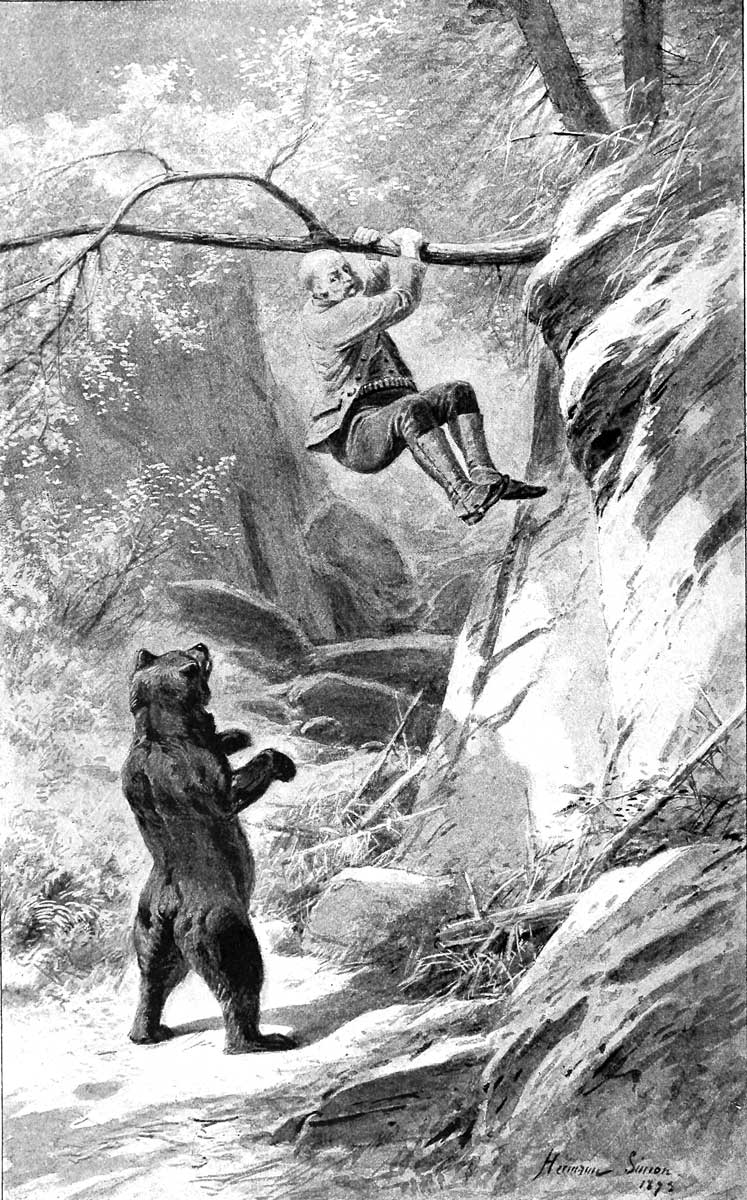
I could hear his labored breathing as it came thick and hard from his herculean efforts to mount that almost perpendicular wall. Hat and gun were abandoned in the mad scramble for safety. He climbed with both hands and feet. I never saw a man more dead in earnest in my life. High up above him was a ledge stretching over which was the limb of a tree that grew out horizontally from the rocky sides.
Now Parkins reasoned within himself—if he could reach that ledge and get on to the limb, he would be safe, for he could pull himself into the tree and thus escape. He redoubled his efforts and, in a moment more, stood on the ledge. As if placed by Providence, he found there two crevices, the highest of which was even with his eyes. Quickly mounting, he prepared to spring to the limb, then paused. Was it not temping Providence to take such a jump as that but, on the other hand, was it not tempting something worse than Providence to remain where he was?
That settled it. With a wild leap in the air Mr. Parkins succeeded in grasping the coveted branch—not a moment too soon—the bear had reached the ledge—where, on finding his victim had escaped, he arose on his hind legs growling fiercely and making frantic endeavors to claw the extremities of my friend. Finding these efforts to be of no avail, he dropped down on all fours again and surveyed the dangling form above him with burning eyes.
All this had happened in much less time than it takes to tell—and yet it seemed an age to Parkins. He couldn’t pretend to pull himself up that limb—he struggled—he got red and purple in the face by turns—his great legs went round and round like the arms of some giant windmill, but all to no purpose—higher he could not get.
In the midst of one of these violent exertions an ominous cracking was heard. I knew what it meant—Parkins was about to descend on the back of the unsuspecting bear; the tree could not stand that strain—go he must and go he did.
“Crack!” went the sharp report of a rifle, and a bullet went whistling and singing over my head to bury itself in the heart of Parkins’ tormentor. I turned. There on the cliff behind me stood the hunter, calmly leaning on his rifle.
“A close call that, sir! Are you hurt?” he shouted over the gulch. “I didn’t get here none too soon,” he continued, making his way to where I stood; and then we went to see Parkins, who was picking himself up from the back of bruin where he had landed fair and square, mashing out what little breath the bear had in him.
Our friend had put the drivers and dogs into the brush and, after giving them a good start, had hurried back to us where he had just arrived in the nick of time. I thanked him with all my heart. As for Parkins he was too full for utterance. He grasped the hand of the man whose sure eye and steady nerve had proved of such value and gave it a squeeze that would have done credit to the dead bear at our feet.
With the exception of a few scratches and a general shaking up, he had not been hurt, but he had gone through an experience that made a lasting impression on him. The drivers and dogs had come up by this time, so leaving the former to skin the bear and take the best parts home for the table, we followed the latter, who had strung out down the gulch after the other bear.
Half an hour’s sharp walk brought us to the mouth of the gorge where he had evidently taken a stand to do battle, for when we arrived there the dogs were making a terrible to do.
“No doubt he has taken to his den,” the guide said, “an’ if he has, there’ll be some tall fitin’, and don’t you forget it; they won’t fight much if you ketch them away from their dens, but when they’re in their home, and particular when they’ve got young, they’ll fight worse than a coon. That was a big one we killed, an’ he was wounded; that’s the reason he chased you. Whatever did you run for, in the first place?”
“There were two of them,” said Parkins, “and while I did not mind one so much, you see I couldn’t stand two coming at me open-mouthed.”
“Well, I can’t say that I blame you, ’cause I’ve done the same thing myself before today; but let’s see after the other feller,” said the hunter and, suiting the action to the word, he led the way to the dogs who had not ceased barking from the time we arrived in earshot. We found them on the far side of a small clump of trees, and there at the foot of a monster oak they were yelping and springing in the air in the wildest excitement.
“We’ve got him now, fellers,” said Mark. “He’s in that tree. Look!” And there he was, sure enough, about 30 feet from the ground, sitting in the crotch formed by a great limb growing out of the tree’s side, and eyeing the dogs in the most unfriendly manner.
“Now, you two fellers just put your guns up and when I count three, cut loose into him.” We did as requested and, when the hunter had slowly counted three, there were two distinct reports and we had the extreme satisfaction of seeing the bear take a wild lunge in the air and come crashing through the branches, narrowly missing one of the hounds standing in his way.
“Well done! You must of shot him in the head,” cried our friend and, going up, we found him quite dead. There was one bullet hole—and it was in his head. Who put it there we never knew, for our rifles were of the same bore. We did not discuss the matter. We had killed a bear—that was enough. Each took a robe with him when we left the hunter in his far-away mountain cabin; and though many years have now gone, mine still adorns the back of my easy chair, ever reminding me of that happy exciting time, and of Parkins.
This article originally appeared in the November 1892 issue of Outing.