
“Got you set up to hunt with Don Richardson,” said Greg Simons with Wildlife Systems when we visited about my upcoming pronghorn hunt in western Texas. “Don knows the ranch you’ll be hunting and will have scouted it before you get there. When I did the annual game survey of the property I saw numerous really good bucks, but there were three standouts.
“One is extremely massive and long, but lacks a prong on his right side” he noted. “If he had both prongs, he would make the Boone and Crockett record book.
“Another is a buck that was part of the additional stocking they did on the ranch when populations got really low a few years ago. That buck is probably eight years old. He’s got massive horns with long prongs.
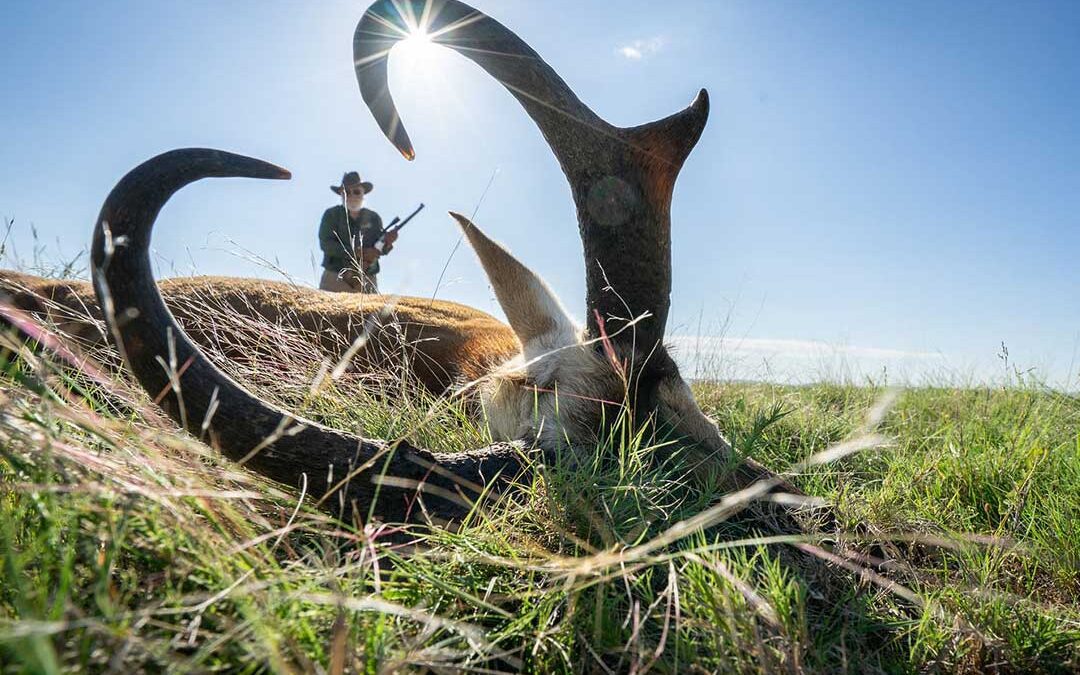
“The third buck is one I personally really like, Don said. “He’s at least 16 inches and his tips curve inward, making his horns look lyre-shaped. See him in profile and he doesn’t look that long, but when he looks at you, or directly away, he’ll grab your attention.”
“Sounds great” I replied. Don has been my guide several times in the past when I hunted with y’all. He knows his business and is fun to hunt with. Thanks!
“That last buck you mentioned sounds really interesting. My longest-horned pronghorn so far is almost 16 inches, I shot him several years ago in Colorado. That long-horned buck sounds interesting, and, I really like the lyre shaped horns. Those other two sound like they might require closer inspection as well.”
The pronghorn is one of North America’s true wildlife conservation success stories. They were brought back from extinction, thanks to the interest and dollars provided by hunters. As our only true plains game animal, they’ve steadily increased in number, thanks to trapping and relocation by game departments who have reintroduced them into their former ranges where they flourished.
Back in the 1970s, I was involved in such a program. Over a couple of years, we trapped and moved hundreds of pronghorns from a prolific herd to many different areas across the northern and western part of Texas.
A few years ago, due to extreme droughts and some health problems, pronghorn populations in Texas Trans Pecos region decreased. Once the drought broke, the Texas Parks and Wildlife Department initiated another trapping and relocation program. Among the areas where pronghorn populations were augmented is where I would be hunting near the small town of Marathon. It was one of the transplanted bucks that Greg referred to as being tagged.
In terms of beauty, the pronghorn truly is the “Dandy Prince of the Plains.” The bucks are truly handsome with their reddish-tan and contrasting white bodies, and their dark face, cheek patch and horns. And, they truly have horns, as opposed to antlers.
The pronghorn is unique in other ways, as their species is the only true-horned animal that has a branch or prong. They are also the only antelope that annually casts or sheds the outer horn sheath and then grow another the following year. Often new growth pushes the former growth off of the horn’s core.
Known for their speed, which can exceed 55 miles-per-hour, they also have an interesting and truly unique “filter” through which air passes on the way to their lungs. This internal filter screens any debris they might inhale as they run with their mouths open. In so many ways our North American pronghorn antelope is unique.
I often hear pronghorns referred to as “goats” or “speed goats.” Personally, I find these terms demeaning and disrespectful of the grand animals they truly are.
Over the years, I have hunted and taken pronghorns with a variety of firearms, from handguns, to bolt and single-shot rifles to .50 muzzleloaders. Pronghorns can certainly be shot at long range in the relatively open country they live in, but for me, it’s more enjoyable and exciting to stalk as close as possible before pulling the trigger. That said, I have taken the occasional long shot, which to me means in excess of 500-yards when it was a particular buck I badly wanted and simply could not get any closer.
In preparing for my hunt with Wildlife Systems (www.wildlifesystems.com), I considered several rifles, all Ruger Number 1 single-shots. Those in the final running were chambered in .275 Rigby, .270 Win., and .257 Roberts, all RSI models (short barrels with full-length Mannlicher-style stocks). I settled on the .257 Roberts shooting Hornady Superformance, 117-grain SST bullets. From a rock-solid rest, I could put three shots touching, 1 ½ inches high at 100 yards. Using my tripod shooting sticks, I shot several two-inch, three-shot groups at 200 yards. That was one of the reasons for choosing the .257 Roberts. The other was that during my early years as wildlife biologist, back when we were collecting many animals for research purposes, my personal collection rifle had been a .257 Roberts. So there was a nostalgic reason as well.
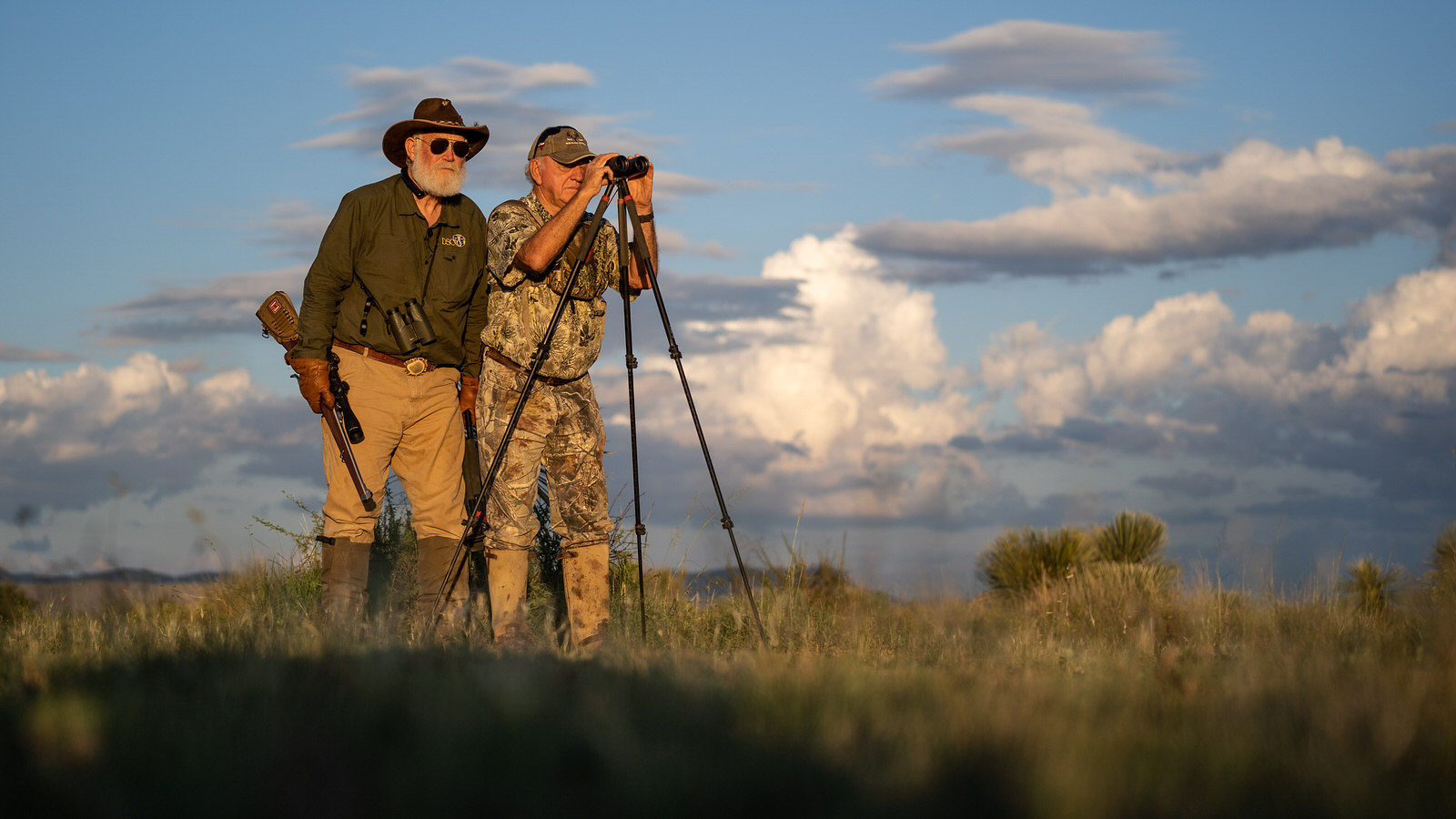
On the first morning of my hunt, Don and I glassed many bucks and does. I passed on several, among them a buck I had spotted a from long way away. By taking advantage of scattered bushes, often crawling on hands and knees, we cut the distance to 200 yards. The buck’s dark horns were tall and long. Previously, I had measured ear lengths of several bucks in the area, as well as the distance from the eye to tip of nose. Both measured seven inches. A pronghorn’s eyes are usually at least one-inch in diameter. Using these for comparison, I guessed the buck’s horns (twice the length of the eye to nose measurement, plus what looked like two eyes widths) were 16 inches in length. He had good mass, but he lacked any prong length. A friend of mine later that same day shot that buck. Both horns measured just over 16 inches.
Another buck we stalked really tempted me. His horns were at least 15 inches, and both prongs flared outward. Truly impressive and handsome.
Don probably thought I was crazy for passing up both of those bucks.
While hunting last in the afternoon hunting in the southern part of the ranch, we spotted what looked like an extremely massive and tall buck, but upon closer inspection through spotting scopes, it became obvious he had somehow broken both prongs. No doubt, had his prongs been present, I would have done all in my power to take him. As we turned to walk away, I looked over at Don and remarked: “That one I’m coming back for next year!”
Early the next morning, we started on the southeast side of the ranch and headed northwest so we would have the sun more or less at our back and the wind in our face. We had hardly started glassing when we began seeing pronghorns: does and fawns, small bucks, nice bucks and a couple of truly “almost” bucks. I admit I was being more selective than I normally would have been. I wanted to take a look at the buck with tall, lyre-shaped horns before squeezing the trigger.
Just after a field lunch, we spotted a herd of does, and immediately behind them, the lyre-horned buck. He was standing about a thousand yards away, with no cover between us and him.
“There’s no way to stalk that buck, Don observed, “but I really think you need to get a closer look at him, And, if you do I suspect you’ll shoot!”
“Don, I got an idea! A few years ago, while hunting pronghorn on the TO Ranch in northeastern New Mexico, Bridger Petrini and I stalked a really nice buck under similar circumstances. But there, we had a horse that we used to hide behind to get closer. The pronghorn in that area frequently saw horses.”
Don nodded, then noted: “Remember the Jeremiah Johnston movie and the statement “Elk can count legs!” I’ve noticed we’ve driven close to pronghorn because they see white pickups like yours on the ranch on a daily basis.
“You could walk on the backside of the pickup as I drive closer. When we get within 250 yards of the buck, if we can, you can sit down and set up your shooting sticks. As I drive away, hopefully the herd and the buck will concentrate on the pickup and not you.”
“It’s certainly worth a try!” I said with a smile.
And that’s exactly what we did! I walked on the back side of Don’s white pickup as he drove toward the herd. They paid us very little attention as we cut the distance. At about 250 yards, I sat down, spread my tripod shooting stick and rested the barrel of my .257 Roberts. I waited until Don was about a hundred yards away, at which time the buck turned broadside, offering a perfect shot.
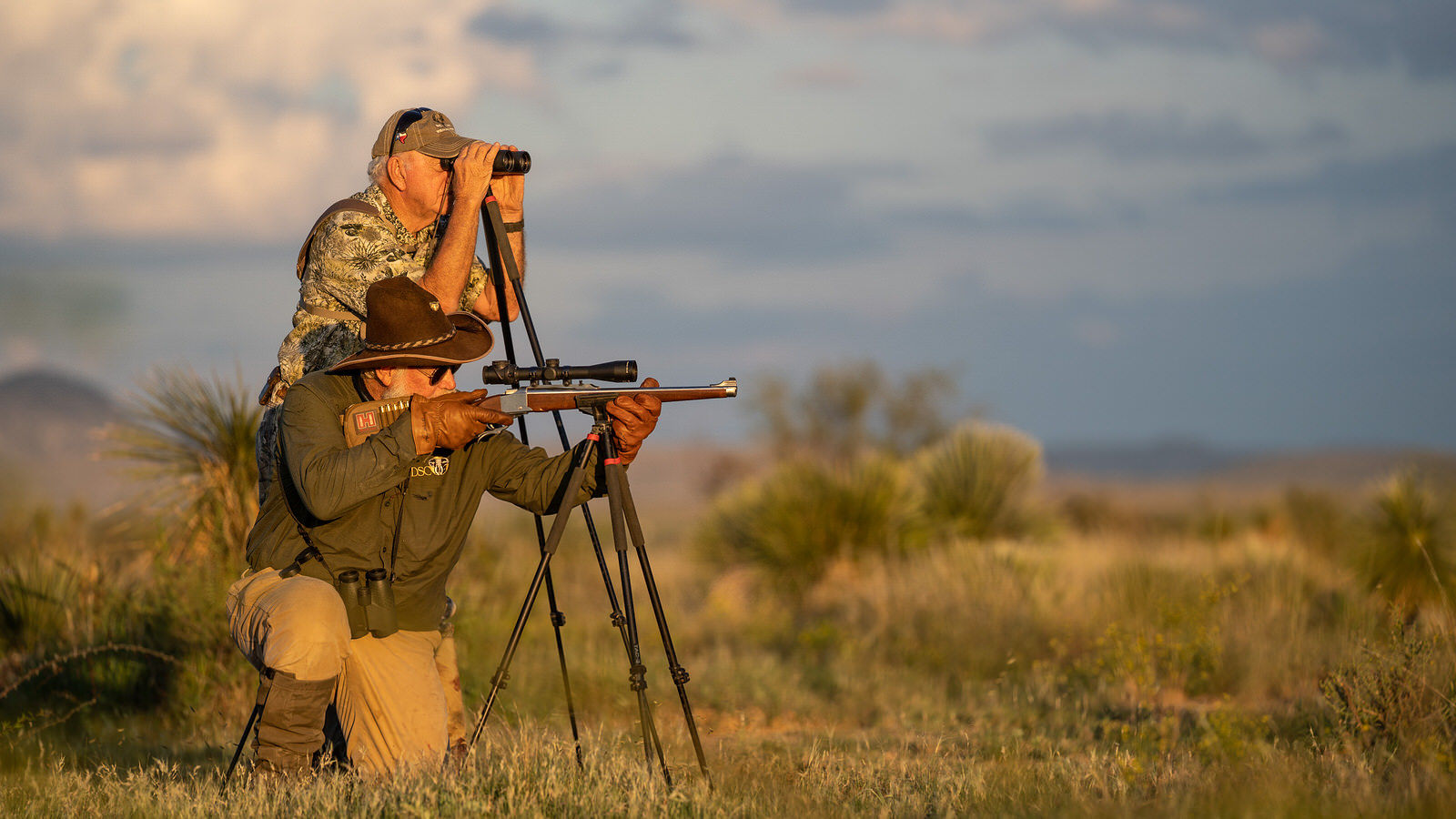
I pushed the tang safety to fire, took a deep breath, let it all out and then pulled the trigger. My bullet passed just under his chest. Evidently, he heard the bullet hit the ground somewhere behind him, because he turned to look in the direction the bullet had gone. As he did, I seated a second round. This time I held a bit higher than my first shot. Shot through the heart, the buck took off at a run, made a small circle and dropped nearly exactly where he had stood when I shot him.
I reloaded and kept my scope trained on the buck. Satisfied he was down, I stood and walked to his side. The closer I got, the longer his horns seemed to grow. No doubt, I had just taken my best pronghorn antelope! I could not have been more thrilled.
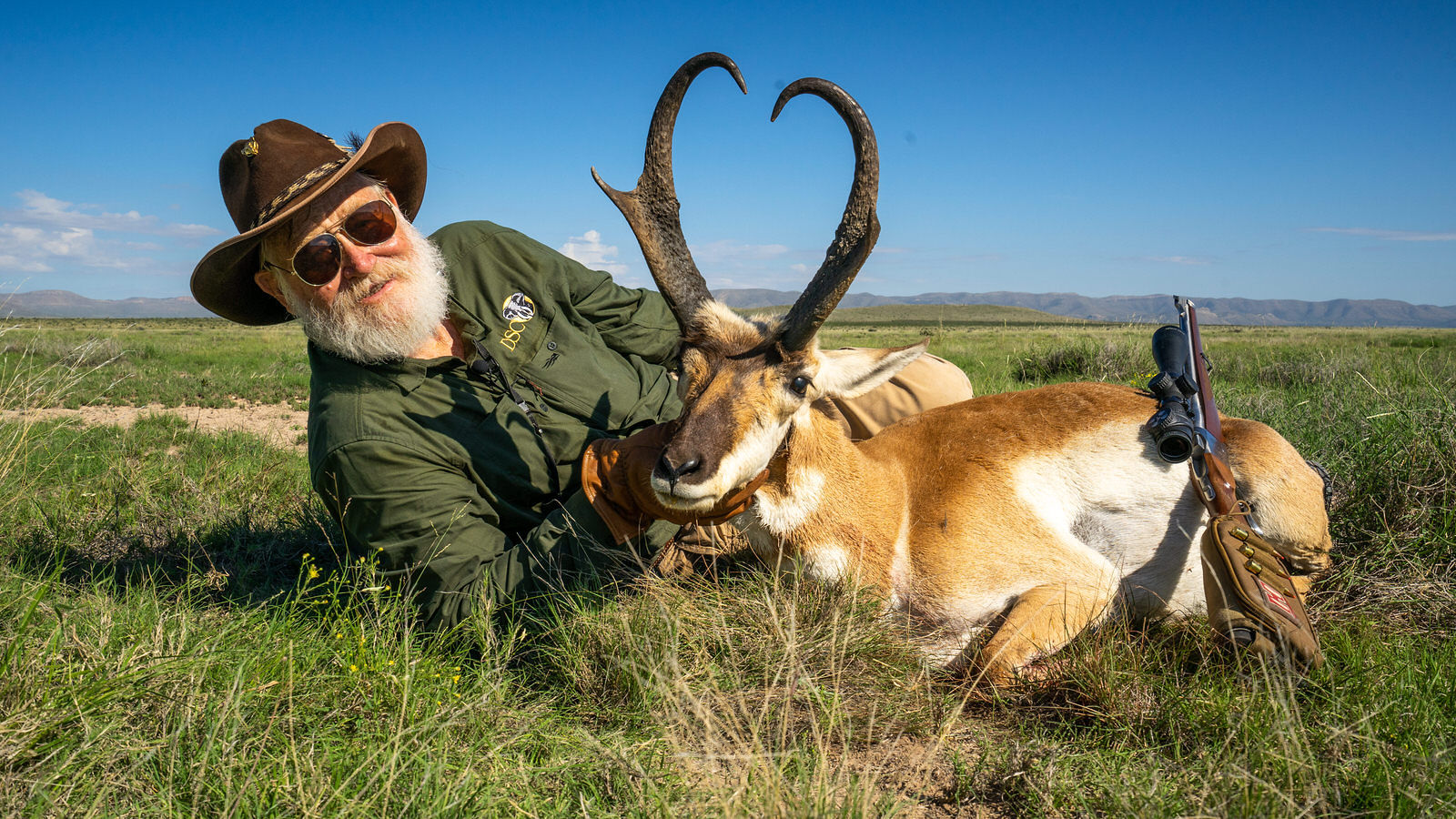
After photos, we headed to camp to get the meat in the cooler. Once there, we measured my buck’s horns. Both were 16 ½ inches in length. Later, when measured for Boone & Crockett, I learned he just barely missed the all-time record book, where the minimum score is 82. Still, I could not have been more pleased, not just with my buck, but that I had taken him with a classy single-shot rifle.
Long horns with a short barrel. One day I will make it happen again!