
The fundamental issue with Alaska Southeast is there’s so much for the sportsman to do and so little time to do it, despite the kind of dogged weather that can change your hopes and plans in a heartbeat. There are a variety of outdoor distractions in Southeast, but terrain and climatic conditions mean time is a factor in any one of these; the more the better.
Of course, the best in outdoor sport is viewed as a respite from tedious toil; lives rich with struggle, difficulty and general boredom. The agony of mortality should be enough, but some of us want more. Everyone knows they’re circling the drain, but no one wants to believe it. I suppose it is these human lapses that coax me to spend entire months in the wettest part of Alaska, based in a tent, when after a lifetime of arid Southwest existence, I know the odds are great that weather will eventually get on my last nerve.
But weather, after all, is what waterfowl hunting is all about.
A quintessential day in Southeast is the kind we anxiously await all season in tamer parts of wildfowldom. The modern outdoor garment industry has seen to it that we are not only comfortable in the nastiest conditions, but actually cherish these acts of God—if only to justify nearly a Grand’s worth of outlay on duds that inevitably spend more time on hangers than on the marsh.
If foul weather translates directly into fowl weather, Southeast, then, defines some form of duck-hunting Nirvana. So then, here I am again.
Heading out from Cordova, the 206 Cessna glides smoothly, swiftly, following the ragged line of Pacific shoreline intersected at imprecise intervals by an intractable succession of rivers, marsh, estuaries—all full of salmon, all harboring ducks in unfathomable numbers. Waterfowl untapped and wholly unmolested . . . Only a moose, or obsessive duck hunter, could love such country, even on a bright mid-September day such as this.
Master Guide Charles Allen, owner of Knives of Alaska and Alaska Expedition Company, a premier fishing and waterfowling lodge on the Tsiu River south of Cordova, handles the yoke. Friend and The World of Hunting & Fishing television producer, Ted Jaycox, shares the front seats. They’re catching up via mic-equipped headphones. I gaze out Plexiglas and note sites of past adventures, if that is the proper term for what I have encountered in this place, including at least one near-death experience with Ursus horribilis.
To the south, the Martin Islands—where I once gunned exotically plumed harlequins and old squaws during a humbling archery stab at a huge brown bear—split ocean currents and describe white-foam streaks and subtle shades of layered green that defy description.
We cut a flank of the Suckling Hills, where I once slipped over the lips of beaver pond dams to pot salmon-egg-fattened mallards as big as lesser snow geese with .44 Mag. shotshells after a weather delayed departure during a disastrous moose foray. We needed the meat.
Soon, we burst into view of the otherworldly expanse of the Bering Glacier, skimming over translucent, milky-blue glacial water nibbling at the ice-field terminus, the violent beginning of the Seal River. Here, on yet another moose hunt, during rare calm nights the calving ice sounded for all the world like distant artillery fire and occasionally woke us with a start as ice walls grumbled and crashed into water to create the perpetual litter of aimless icebergs.
It seems strange to see these places again, only in that I know them well and by name after so many hours of stalking its rivers and forests.
Kismet, by hook or by crook, has unaccountably deposited me here repeatedly; always with quiet trepidation, borne of a necessity to hand over control of my destination and fate to relative strangers. Southeast offers the aerial sojourner the most gorgeous vistas left on earth, but ground level is filled with myriad pitfalls—nervous expectations high among them.
As uncharacteristically pleasant as the weather has proven on the flight in, it’s brutally nasty the next morning. Natives labeled this river Tsiu, “Place of Wind,” long before Europeans arrived to officially clock its gales, recorded at 100 miles-per-hour with regularity by the National Weather Service in Yakutat down the coast.
Blowing beach sand creates whiteout conditions, which along with the rain-blasted environment on the Tsiu/Tsivat estuary, make it impossible to launch the Go-Devil skiff that serves as logical and necessary transportation into the best duck holes.
It’s difficult to look on this as a Greek tragedy. Charles’ German-born cook, Chef Keem, assures that we will remain well stuffed on fodder such as shrimp quesadillas, the best seafood chowder I’ve ever put in my mouth, lamb chops, blackened salmon, fresh pastries . . . I could go on, but you get the picture.
In the rustic lodge, we share angling stories with the five visiting guests, watch a few Hollywood movies on VCR, eat and read and relax in a way that’s been impossible for me for more than a year of hectic existence.
In the next two days, we’ll get to know each other in a good many ways.
Then, sometime deep in the third night, there is a sudden calm that wakes me with its silence. I sense Ted is listening as well.
“Looks like we’re duck hunting in the morning,” he says, and we roll over and go back to sleep.
It is black morning, four of us crammed into the salt-rusted, implausible Jeep barged in during seemingly another era, its ineffectual heater fan squealing as we bump along over newly-created dunes covering what was once a well-traveled track leading to the Tsiu’s most productive salmon holes.
Charles swerves the uneven headlights across the lapping river, plowing the Jeep straight in and across a vast nothingness of restless water. Small waves begin to crest the hood, and we hold our breath as the Jeep lurches and steam rushes up though the floorboards. In minutes the jeep climbs out, shakes itself off and then pushing through hub-deep water another mile to arrive atop an exposed swatch of sand remarkable only by its stature as an unremarkable landmark.
Across a deep channel of patient current, behind a low island of red alder, willows and scrubby Sitka spruce, rests the Go-Devil skiff, very much in need of bailing. Ted and I work to untangle decoy lines tossed and stirred by ocean-like waves during the storm. In the end, I produce a jackknife and began hacking line so we can start the process from scratch.
The land slowly reveals itself. We might be considered behind schedule by Lower 48 standards, but we are just in time for Alaska. We need the growing light to discern the river’s burden of spring run-off logs, tangled weed beds and assorted treacheries. It also provides opportunity to take in our surroundings, to tweak our anticipation.
Huge trumpeter swans go out before the humming Go-Devil with raucous slap-slap-slaps on the water before gaining altitude and cutting stark-white silhouettes against the multi-layered pastel sky.
Rafts of bluebills and redheads and canvasbacks wheel from open water, forming tight formations that set down again at a safe distance. Fat mallards flap and squawk in alarm from around sudden bends or from within isles of floating marsh grass. Widgeon whistle and peep and hopscotch in short arches to stay ahead of the skiff.
I’m quivering and as anxious as my female Labrador at home; the way she gazes at shadowy, decoy-fooled birds, impatiently awaiting shooting hours. It’s like refuge water reserved just for us.
We slide into a cove as the day opens a few more F-stops, the sun peeking over the Robinson Mountains and under high-scudding clouds to set afire the Wrangell-Saint Elias Range and its layers upon layers of snow and glacier ice, the ranges behind succeeding each other to the north into blue eternity.
We remove the decoys—widgeons, standard-issue mallards, gads and teal, and two monstrous, white swans—from the boat, then Christopher de los Santos, Charles’ top fishing guide, heads up the Tsivat with the Go-Devil to scope out the steelhead situation.
When the purring skiff rounds the next bend, there is nothing but the Pacific pounding in the middle distance, twisting wedges of sandhill cranes chortling high overhead in their prehistoric language, and the constant quacking and squealing and whistling of ducks at every hand.
The ducks attempt to land on our heads while we toss out the decoys and place the faux swans at the head of the procession. Charles explains the swans—real swans—are able to stir bottom at a deeper level, attracting ducks that squabble over the scraps.
Our blinds consist of nests sawed into thronged alders and overturned five-gallon buckets for seats. Ted and I alternate operating the digital camera and wielding a single shotgun provided by a sponsor, its 20-gauge chambering made more effective by the Hevi-Shot we scrounged in Cordova while playing tourist. Charles expertly plays his duck call and handles a 12-gauge Browning over-and-under that’s really too fancy for the duck marsh.
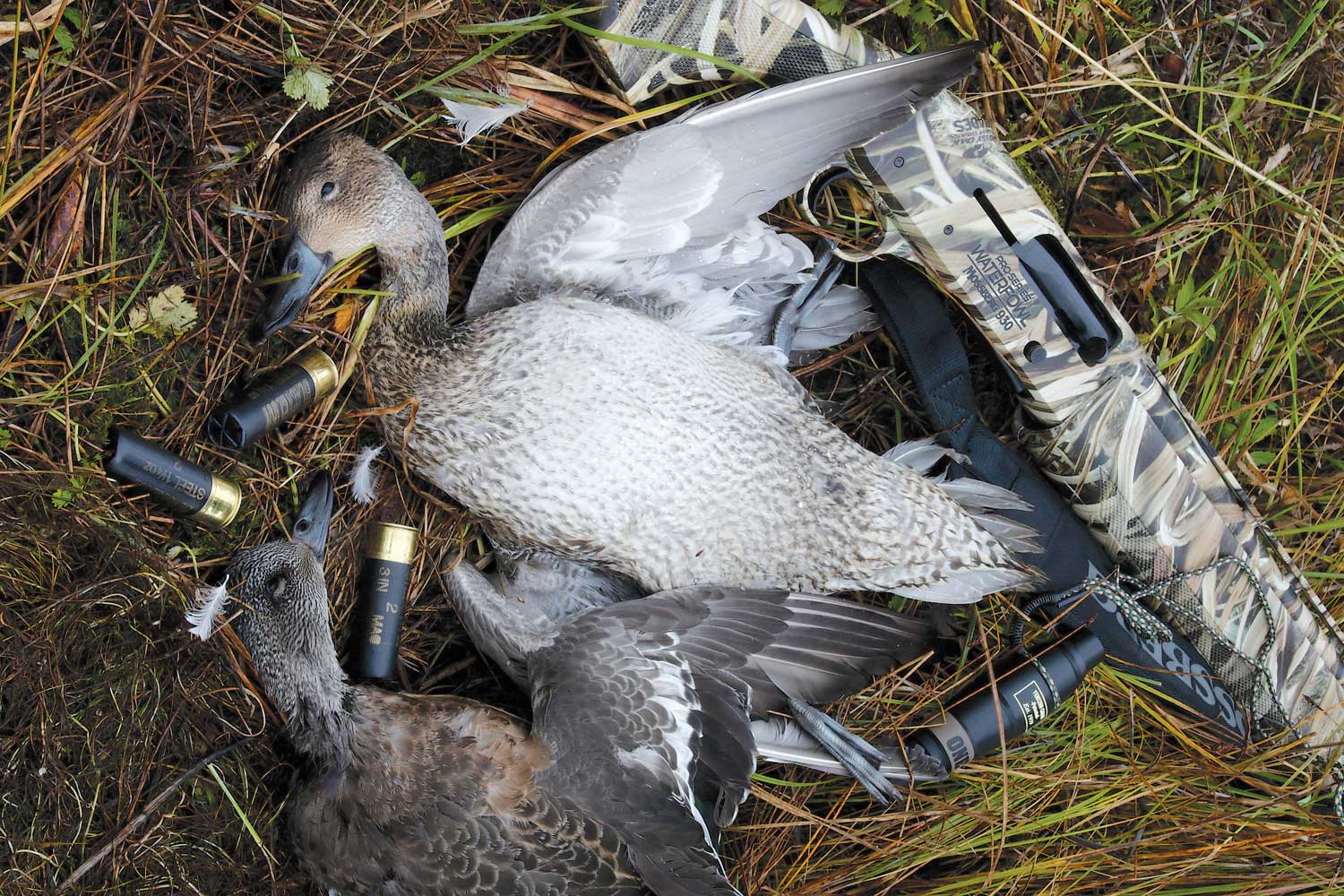
Mossberg’s durable and reliable 930 semi-auto with hen pintail and American widgeon.
The ducks come diving and swirling into the dekes just that quickly—puddlers all—mostly widgeons with the occasional mallards, gadwalls and pintails. They come in even interims, in threes and fives and baker’s dozens.
Charles calls the shots, grunting into his call between polite cautions, twisting and forming pirouettes to keep them in sight—pairs and triplets splitting off the masses to try the decoys, swooping in, completely committed.
“Take ’em!” The crashing of guns. Hard splats on cold water. One of us labors out to them hurriedly, returning in crouching gestures as more ducks wing into our air space. And we are on again. Some of them flare away, as you expect them to, but most of them do not. They are not suicidal, but they are certainly willing.
It all reminds me of the very best days at home, accessing several years of memory, yet we’ve been made to understand it could be better here. As it is, we all collect limits three hours in, when high-sailing clouds begin to settle and sift a dimpling rain and the expensive camera needs to go under cover. As if on cue, Christopher returns with the skiff.
By the time we reach the Jeep, the weather has assembled into a minor hurricane and we are wet and hungry and glad to be off the water. Of course, we understand Chef Keem will have something wonderful waiting for us in the lodge. We smile, contemplating what he might create from our morning’s bounty. The man never seems to leave his kitchen.
The next morning is as still as the inside of a church while Ben, one of guides, bails the skiff and Charles does whatever it is people do to make wet, cold motors function on command.
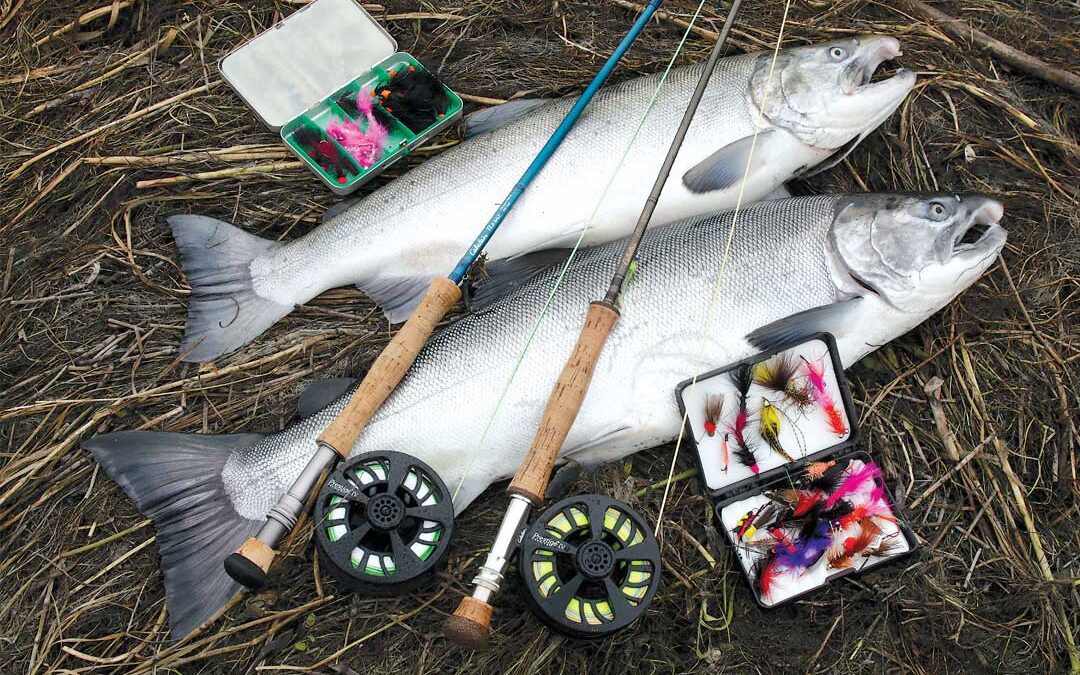
Gazing almost blankly down at the current, I see a characteristic swirl and reach for my fly rod, stowed for later fishing. Quickly, I strip line while false-casting and wading forward, then drop the garish chartreuse fly into a seam created by a ball of roots. After stripping twice, I come up tight on something heavy and implacable. The fish rolls once in his temporary confusion, and I can see he’s a silver salmon, bright from the sea, wearing an alligator’s hooked snout. Ted wades around me with an arm-load of gear and shakes his head, laughing. The salmon rushes downstream to impart that temporary feeling of helplessness, peeling line from a protesting reel.
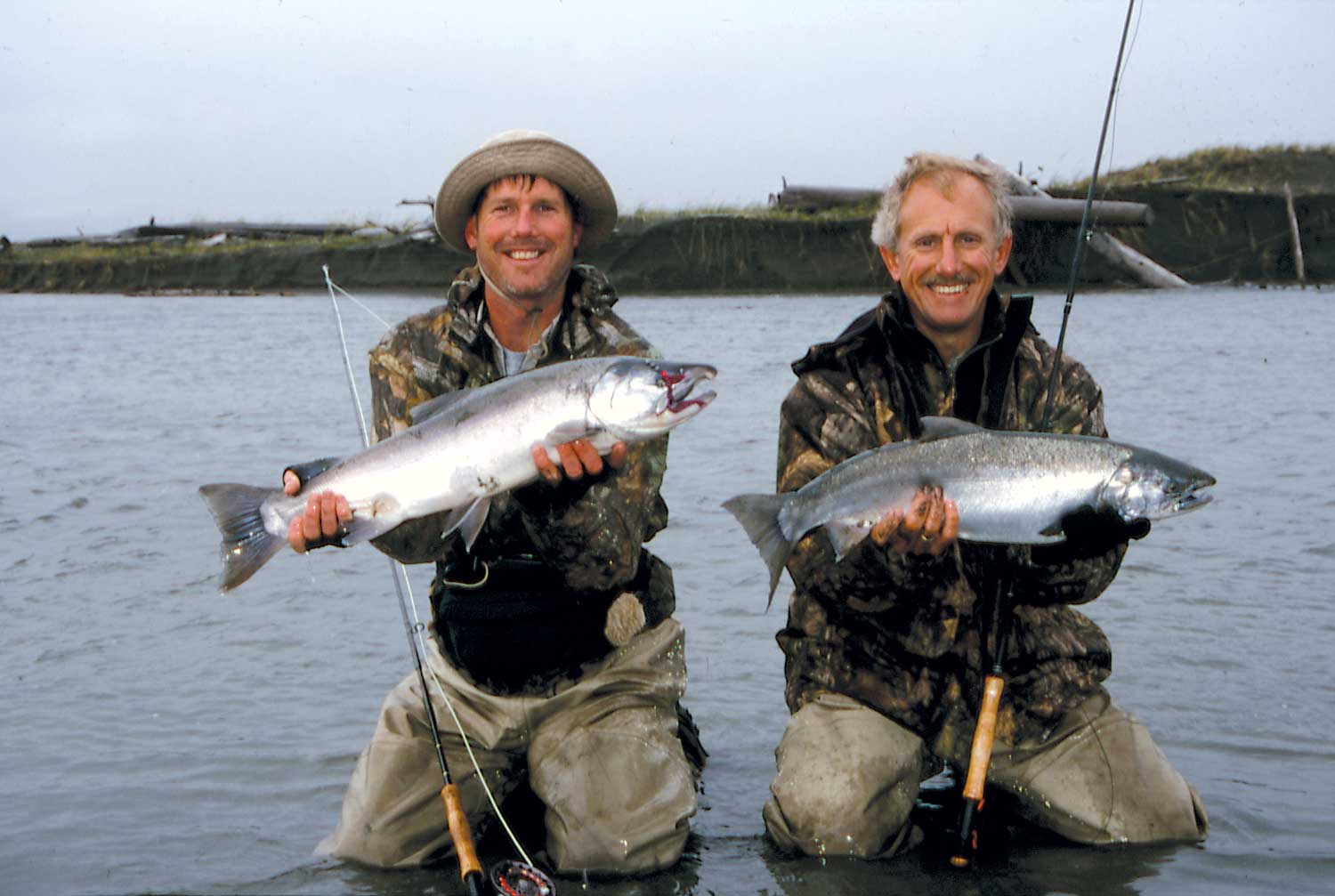
Patrick Meitin, left, and friend Ted Jaycox show off a double on hefty silver salmon only a mile upstream from the sea.
Soon I’m being observed impatiently. I am holding up the show, but the salmon and I are irrevocably connected, and I am unwilling to break that precious link. They will have to wait until he slides up the smooth sand firmament, flopping like a lost hubcap at the shoulder of an empty expressway. I slip the hook from his jaw and urge the 16-pound fish back into the current.
The water is glass smooth, but the eastern sky walls high in an ominous black bank of churning clouds, like a Biblical plague poised to roll over the land. The air is so still and transparent I can hear everything.
When we glide into the familiar cove, the disturbed water radiates like visible sound waves, finally made indistinct by distance. Tossed decoys slap the water like depth charges in the still air.
The ducks are not moving, which is to say they are not as active as the day before. But still they come. We make up for what is lacking in numbers with smart shooting.
I swing the camera with a pair of widgeon banking over the decoys, hear two even blasts, and catch both splashing to break the mirror surface, blurring the reversed image of Mount St. Elias’ peak some 18,000 feet above, endless white fading to red and purple berry shrub, the green Sitka spruce behind giving way to a golden streak of fall poplars and cottonwoods.
We puzzle over the first white-hot flashes, hear the echoing thunder. It occurs to me this is out of place as I remember where I am. The water begins to stir. More ducks arrive. We are shooting our barrels warm. Then the first dollops of rain arrive, splattering and ice cold.
We are close to limiting, but an immediate retreat is indicated.
We hole up in the lodge against weather another day, then use the final bright morning to check out the Tsiu River and its world-renowned salmon fishery, the free-loading Dolly Vardens intent on roe and the sea-run cutthroats, though I’m hoping against hope for a prized steelhead. It can be honestly described as non-stop action, and I am left to wonder if, like the duck hunting of the Tsiu, is it too much of a good thing, something that will blunt my appreciation of the waterfowling back home, desensitizing my perceptions of the natural beauty now surrounding me—the pounding, seemingly angry surf behind; the busy, screaming gulls and intricately layered ice and vegetation spilling from nearby mountains; the cackling of geese and lonely cries of sandhill cranes home from Siberia.
So I steal a moment to soak it all in, smiling to see a raft of teal dipping and swooping to skim the Tsiu’s surface, clawing to gain altitude and clear the regiment of anglers and their waving rods and swishing line. I place the rod butt to my shoulder and sight along its length to follow them.
Bam! Bam! I understand how good I have it, but also that wherever you are standing, things are just as they should be.
And I can’t wait to come back. Yes, I’m already thinking of a return to Alaska Southeast, and the place of wind.
IF YOU WANT TO GO
For more information, contact The Alaska Expedition Company at (800) 572-0980, or visit alaskaexpedition.com.