
During the 50 years between the end of our Civil War in 1865 and the start of the First World War, American wingshooters had an extraordinary number of choices in double barrel shotguns, both foreign and domestic. This article is about classic imported doubles that were in the hands of American hunters during what is often described as the Golden Age of the double barrel shotgun.
The vast majority of double barrel shotguns imported into the United States during this period came from three European countries: Great Britain, Belgium and Germany.
In Britain, the industrial city of Birmingham located in the English Midlands near supplies of iron and coal, has been the epicenter of metal work and gunmaking since the early 1700s. In the late 19th century and early 20th century, most of the iconic companies making the highest quality shotguns for the aristocracy and wealthiest British citizens were in London. However, the largest concentration of shotgun manufactures was in Birmingham, including the major exporters to the United States.
Among companies exporting good-quality doubles that competed with the premier American brands at the middle of the market ($50 field grade guns to $80 quality-level 3 American guns) were J.P. Clabrough, C.G. Bonehill and T. Bland. [For context, $1 in 1880 was roughly the equivalent of $100 today in purchasing power.] Among the British manufacturers exporting high and very-high quality guns that competed at the upper-end of the market ($100 quality-level 4 American guns and above) were W. & C. Scott, W.W. Greener, Westley Richards, Wm. Powell and P. Webley.
In Belgium, the arms industry was concentrated in Liege, which had been a center for military and sporting arms on the Continent since the 1500s. It was an independent principality for much of its history before being incorporated in 1830 into the newly formed state of Belgium. By generally maintaining its neutrality during Europe’s frequent wars, its gun trade provided weapons to many of the warring states.
Some Liege-produced muskets and cannon made their way to General Washington’s Continental Army, courtesy of the French monarchy. Throughout the 19th and early 20th centuries, Liege was a global exporter of sporting arms. Wealthy French, Scandinavian and Russian sportsmen were a prime market for its higher-quality shotguns.
Liege sits at a strategic location on the Meuse River in the northern part of the Ardennes Forest. By the mid-19th century, Liege was a major industrial center with iron and steel foundries and armament factories. In 1909, it had 195 companies involved in the manufacture of military and sporting arms. The largest manufactures, such as H. Pieper and Fabrique National (FN), owned large, fully integrated industrial plants capable of large-scale production of complete guns. However, most of these companies were small family-run businesses that for decades, if not generations, had been making locks, stocks or barrels.
Accustomed to the international market, Liege companies were well positioned to enter the American market quickly and in force after our Civil War ended. They would dominate the American market for good-quality affordable exposed hammer shotguns until 1890, when Congress imposed a 30-percent tariff on their shotguns. Many companies then switched to suppling parts (which were exempt from the tariff) to American shotgun manufacturers. Others remained a force at the middle of the American market, including H. Pieper, Neumann Brothers and Fabrique de’ Armes de Liege, until the Germans invaded Belgium in 1914.
Most manufactures of high and very-high quality Belgian shotguns did not market their guns in the U.S. until after the First World War. A major exception was Auguste Francotte & Son, which came late to the game, but had an impact that would carry forward through most of the 20th century.
In Germany, the center for sporting arms during this period was the city of Suhl. Historically part of Saxony, it became Prussian after the Napoleonic wars and remained so until 1918. Today, Suhl is located in the current state of Thuringia about 200 miles southwest of Berlin. Its gunmaking history goes back to the mid-1500s, with craftsmen brought from Liege playing a prominent role in its beginnings.
Like Liege, Suhl is located near iron and coal deposits and lies in one of the most ancient forests in Europe, the Thuringer Wald. Suhl’s growth was initially based on the demand for military arms driven by frequent wars in central Europe. The transfer of technology from military production to sporting arms was one reason that Suhl sporting guns became famous for their quality of steel and the fine tolerances to which it was machined.
The German Gun Collectors Association website, germanhuntingguns.com, is an extraordinary source of knowledge about German sporting arms of this period. As part of a concise summary of Suhl’s role in the history of sporting arms, it states:
“The years in the second half of the 19th century and the early years of the 20th century up to World War I are considered the golden years of hunting gun production in Suhl. These are the years when all the famous gunmakers like Sauer, Simpson and Krieghoff and importers like Charles Daly … built their reputations…. Population registers of Suhl [show] 75 percent of the whole work force worked on guns, either in the bigger or smaller factories or the many home workshops attached to the back of practically every house…. The bigger factories … did most of the work in their factories, but the smaller makers took advantage of a network of specialists.”
The buyers on our side of the Atlantic would most likely have purchased quality imported doubles from one of the high-end retail outdoor sports companies located in many major cities. Among these were Schoverling, Daly & Gales and Von Lengerke & Detmold in New York City; J.P. Lovell and Wm. Reed in Boston; J. Butler & Sons and Hibbard, Spencer, Bartlette in Chicago; E.K. Tryon in Philadelphia; and Clabrough, Golcher & Co in San Francisco. These companies would typically import shotguns in small batches from a number of manufactures, some by special order. All of the above also ran catalog sales businesses.
The criteria to determine what qualifies as “classic” include: (1) something exemplifies the best of its kind or class, (2) has a timeless quality of beauty or design and (3) has been popular or otherwise valued for a long time.
With respect to the first criteria, defining the specific class of guns and its boundaries facilitate valid comparisons and narrow the scope to allow greater depth of analysis. This article considers only European companies that actively marketed their guns in the U.S. and achieved a significant penetration of the American market before 1915. Six companies were selected:
W.& C. Scott & Son, J.P. Sauer & Son, Charles Daly, W.W. Greener, August Francotte & Son and Westley Richards
Each of the six sections that follow [three in this issue and three in a future issue] addresses one of these companies. Each begins with a general history and is followed by descriptions and pictures of representative shotguns that are still on active duty as hunters.
All the companies simultaneously produced and exported hammer and hammerless guns after 1875. Their specific models also evolved over time. This was largely due to the era’s rapid advances in science, technology and engineering, to which all six companies contributed within their industry.
All components of a shotgun will not necessarily be described in detail or pictured for every gun. For example, when more than one model uses similar locks, only the first to be addressed will be covered in detail.
W. & C. Scott & Son, Birmingham
The firm of W. & C. Scott, which was founded in 1840 by William and Charles Scott, has an important place in the history of gunmaking. After two of William’s sons—William M. and James—joined the firm in 1862, the name was changed to W. & C. Scott & Son. William M. took over the company when his father retired in 1869. He became one of the best practical gunmakers of the era. He was also one of a half dozen inventors in Britain who created the double barrel shotgun as we know it today. He had 14 patents issued between 1865 and 1884. The most significant was a device called the Scott spindle that he invented in 1865. It connected a top lever release with the double under-bolt invented by James Purdey two years earlier. Together they became the industry standard in Britain and on the Continent.
William M. was also a brilliant businessman. Under his leadership, W.& C. Scott was the first British shotgun manufacturer to realize the potential of the expanding market of affluent shooters in America. The History of W. & C. Scott Gunmakers by Crawford and Whatley, the most authoritative source on the company, describes his approach to the American market:
“He promoted the products of the company by regular visits to America from 1860 to 1886 to acquaint firearms dealers with the latest features of Scott guns. In America he organized a network of importers from New York to California … and, as a result, the United States was Scott’s primary market during the last quarter of the 19th century.”
W. & C. Scott was also the “Gunmaker to the Gunmakers,” the sub-title of an article by John Campbell in the Spring 2011 issue of Double Gun Journal. As Campbell explains, it requires a significant industrial operation to forge actions, make and bore barrels and otherwise manufacture the metal parts for a good gun. Scott not only provided component parts to many of the regional gunmakers but also to prestigious firms, such as Holland & Holland, Purdey and Rigby. Scott was also agreeable to engraving the names of British and American retail companies on the guns they ordered.
Scott made many types of side-by-sides, which Crawford and Whatley classify into five categories: game, light game, pigeon, wildfowl and heavy wildfowl. The company categorized the quality of its shotguns as A (fine), B (medium) and C (plain). The boundaries between the quality categories are vague today. To complicate things more, each quality category had several models and grades. The best of the “A” guns was labeled as “Premier Quality” and so marked on the guns. It was manufactured from 1873 to 1921. In 1884 it sold for $275. Some “A” and most of the “B” and “C” quality hammer guns were not identified by model names but by numbers, which unfortunately were not marked on the guns.
Around 1880, Scott started adding more structure, almost certainly for marketing purposes. The Pigeon Club Gun was introduced in 1879 at a price of $175. The Bogardus Club Gun, which was heavily marketed in the U.S. from 1887 to 1892, and its lightweight cousin, the Zephyr, both listed at $100.
Many types of W.& C. Scott exposed hammer shotguns were imported into the U.S. during the last half of the 19th century. They included guns with top-lever, side-lever and bottom-lever release mechanisms; locks of bar-action and back-action design; and game guns, pigeon guns and waterfowlers. By 1880, a wide range of gauges from 4 to 20 were available. However, 10 and 12 gauges accounted for 85 percent of Scott production from 1865 to 1890.
W. & C. Scott hammer guns are best-in-class. However, the company struggled in the transition to hammerless guns from the late 1880s until it was acquired by P. Webley & Son in 1897. The new company, Webley & Scott, continued making shotguns of varying design and quality under the W.& C. Scott brand well into the 20th century. The last Scott guns manufactured before acquisition have serial numbers in the 57000 range.

10-Gauge Bar-Action Waterfowler
The 1876 hammer gun, pictured above with Canada geese, incorporates most of the innovations that came to define the modern double-barrel shotgun. It uses the double-under-bolt locking system invented by James Purdey in 1863. When the top-lever breaks open the gun, a spindle invented at W.& C. Scott in 1866 moves the double bolt forward to bind with both the rear and front barrel lugs. The combination of the Purdey double-bolt and the Scott spindle became the industry standard.
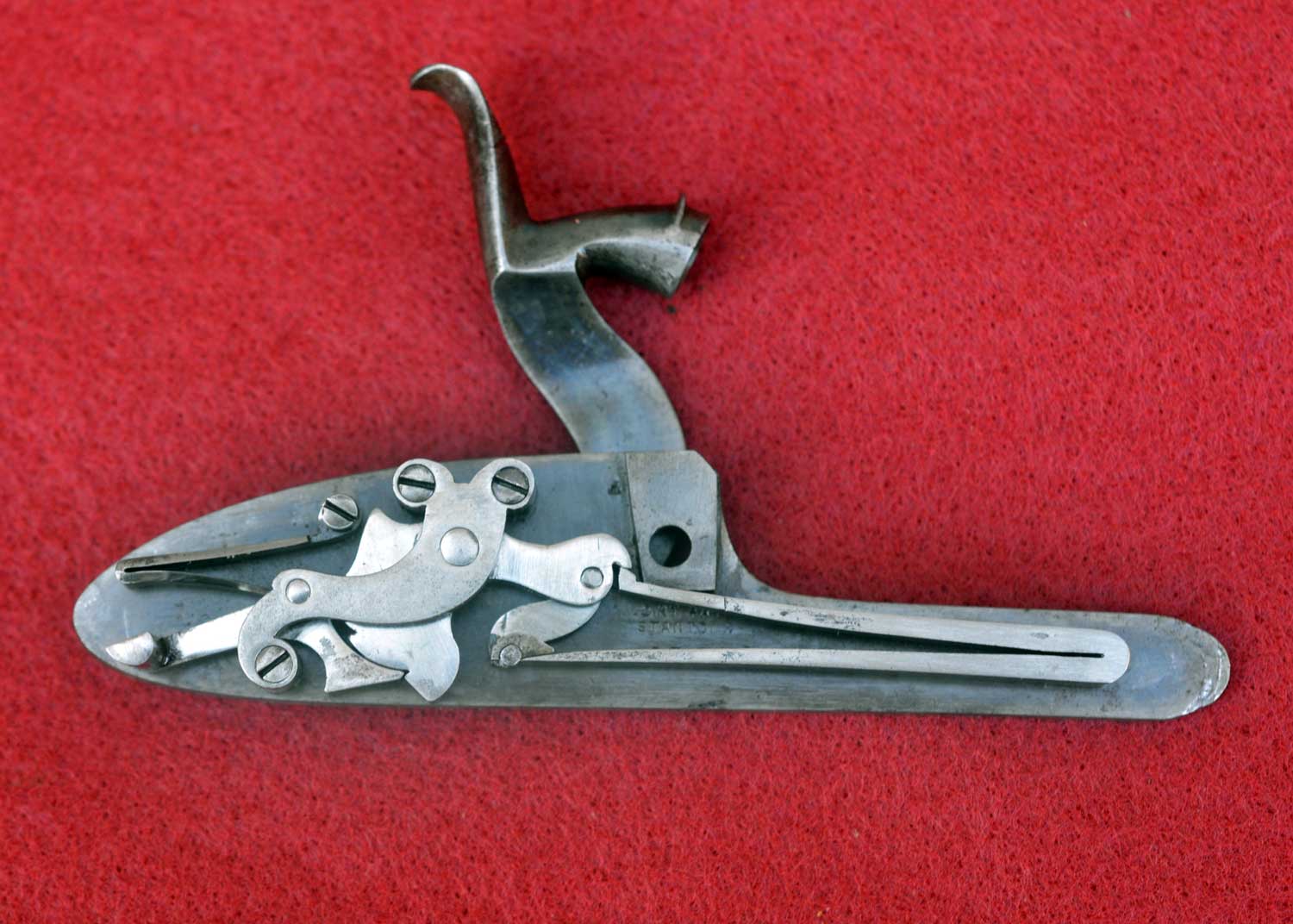
The sidelocks used in this gun are rebounding. This was an important safety factor, first patented in 1867 by J. Stanton, as the hammers do not rest on the back of the firing pin after discharge. The lock used in this gun is marked with the Stanton patent, although Scott would later patent and manufacture its own locks, which were widely used.
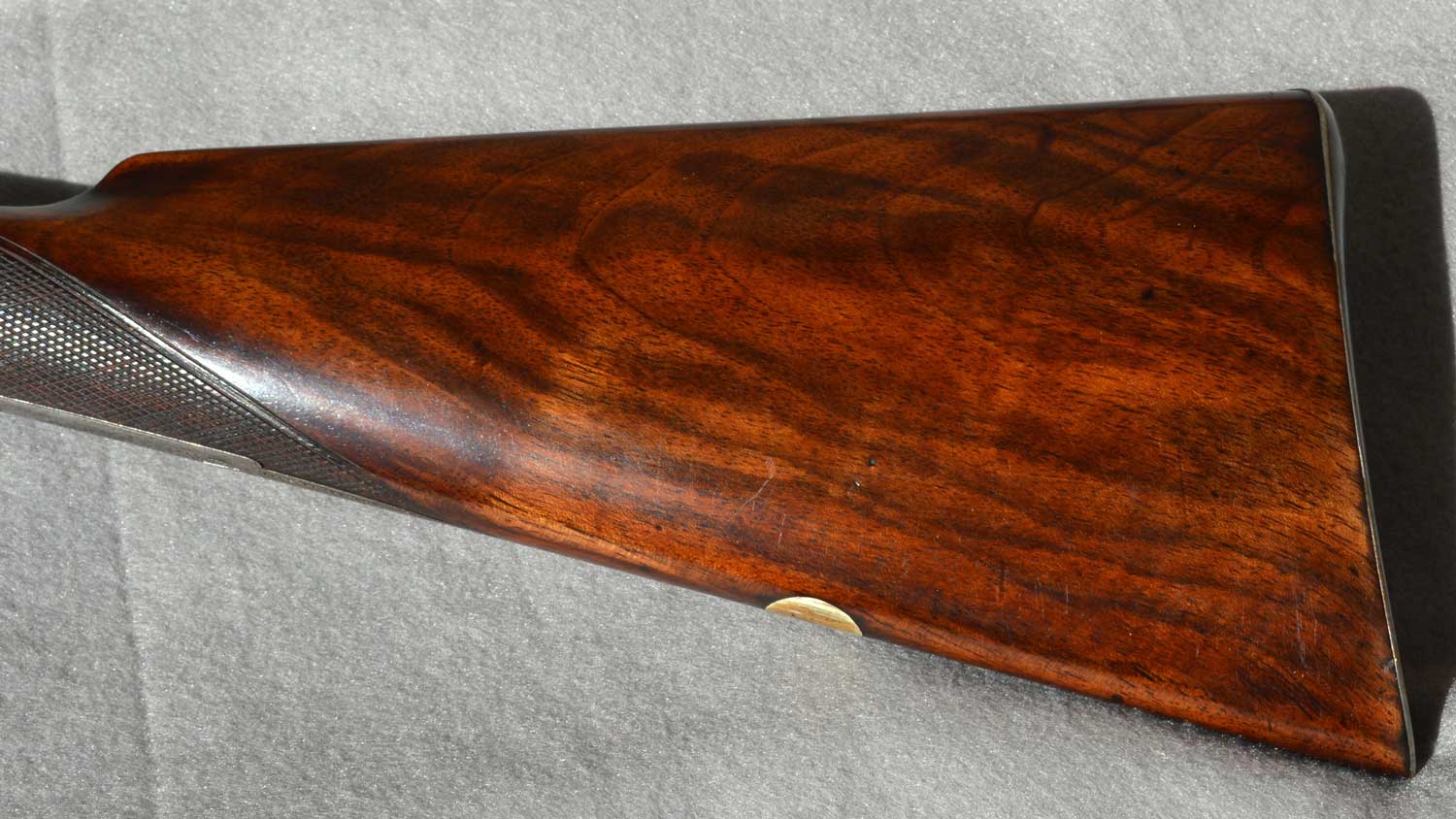
This gun’s figured English-walnut stock has a straight grip with the accompanying relatively thin wrist. As explained by Bill Dowtin in “Stock Wood for Best Guns” (Winter 1993 DGJ):
“The selection of gunstock blanks historically has followed the same five criteria. In order of importance, they are: a. grain layout; b. density or hardness; c. drying and seasoning; d. overall background color; e. figure and how well it is defined.”
The weight of this gun (8 pounds, 13 ounces) would have magnified the importance of grain alignment, with great care taken to ensure that it ran properly through the wrist. W. & C. Scott would have ensured that stock blanks for its better 10-gauge guns were dense and properly dried and seasoned, processes taking from a couple of years to a decade or more. This stock is strong and properly cut, but its uniform background color and limited figure would likely have dropped the rating of the stock blank used to make it to a 3 on a scale of 0 to 6.
The 30-inch Fine (3-rod) Damascus-steel barrels have 3-inch chambers and are both choked full. The process for choke-boring was patented by W. R. Pape of Newcastle-upon-Tyne in 1866 but was not commonly accepted until after W.W. Greener improved the process and patented his boring machines a decade later.

The engraving is classic English style. The right lock-plate has a hunting vignette of a setter and a flying duck; the left a pointer and a standing pheasant. Intricate, deeply cut, shaded English scroll covers most of the remaining space on the locks, bottom metal, top lever and forend iron, leaving only the balls of the receiver unadorned.
The author used this W.& C. Scott hammergun, along with a J.&W. Tolley and a Joseph Lang in a study of the effectiveness of mid-19th century British waterfowl’s in hunting Canada geese. It was conducted on Prince Edward Island over two hunting seasons. Among the study’s conclusions was that “the user of a 19th century British waterfowl need not worry that he or she is ill-equipped to hunt geese on even terms with hunters using modern shotguns.”

12-Gauge Back-Action Game Gun
The 12-gauge, back-action, round-body shotgun shown above was manufactured in 1872. Its lock-plate extends down the wrist of the gun. The mainspring of the lock is located to the rear of the tumbler and hammers. This J. Stanton patented lock is rebounding.

In a bar-action sidelock, such as is used on the 10-gauge Scott waterfowler, the mainspring extends forward of the tumbler along the bar of the lock-plate. By the late 1860s, bar-action guns began to dominate, in part because they were considered stronger and more suitable for heavier loads.
However, back-actions allowed for a graceful design not possible with bar-actions. Moreover, the guns were lighter, and their proponents considered the guns easier to handle and the locks faster. Perhaps for these reasons, W.& C. Scott continued making “B” and “C” grade back-action doubles until the mid-1890s.
The stock on this gun is nicely grained English walnut with 22-point checkering. It has a 14 1/4-inch length of pull. The 30-inch barrels are made of British fine laminated steel, have 2 3/4-inch chambers and are without choke. The engraving is English scroll. It weighs 7 pounds, 5 ounces. While this was not one of Scott’s most expensive guns, its classical lines make it arguably one of its most beautiful.
Charles Daly, New York City and Suhl
August Schoverling and Charles Daly founded the highly respected New York City sporting goods retailer Schoverling & Daly (S&D) in 1865. S&D catered to New York’s wealthy sportsmen, selling guns, fishing tackle, outdoor clothing, camping equipment and other types of outdoor sports supplies. By the time Joseph Gales joined in 1887 and the name changed to Schoverling, Daly and Gales (SD&G), it was located in lower Manhattan on Broadway, only a short carriage ride from the financial district where many of his clients would have worked.
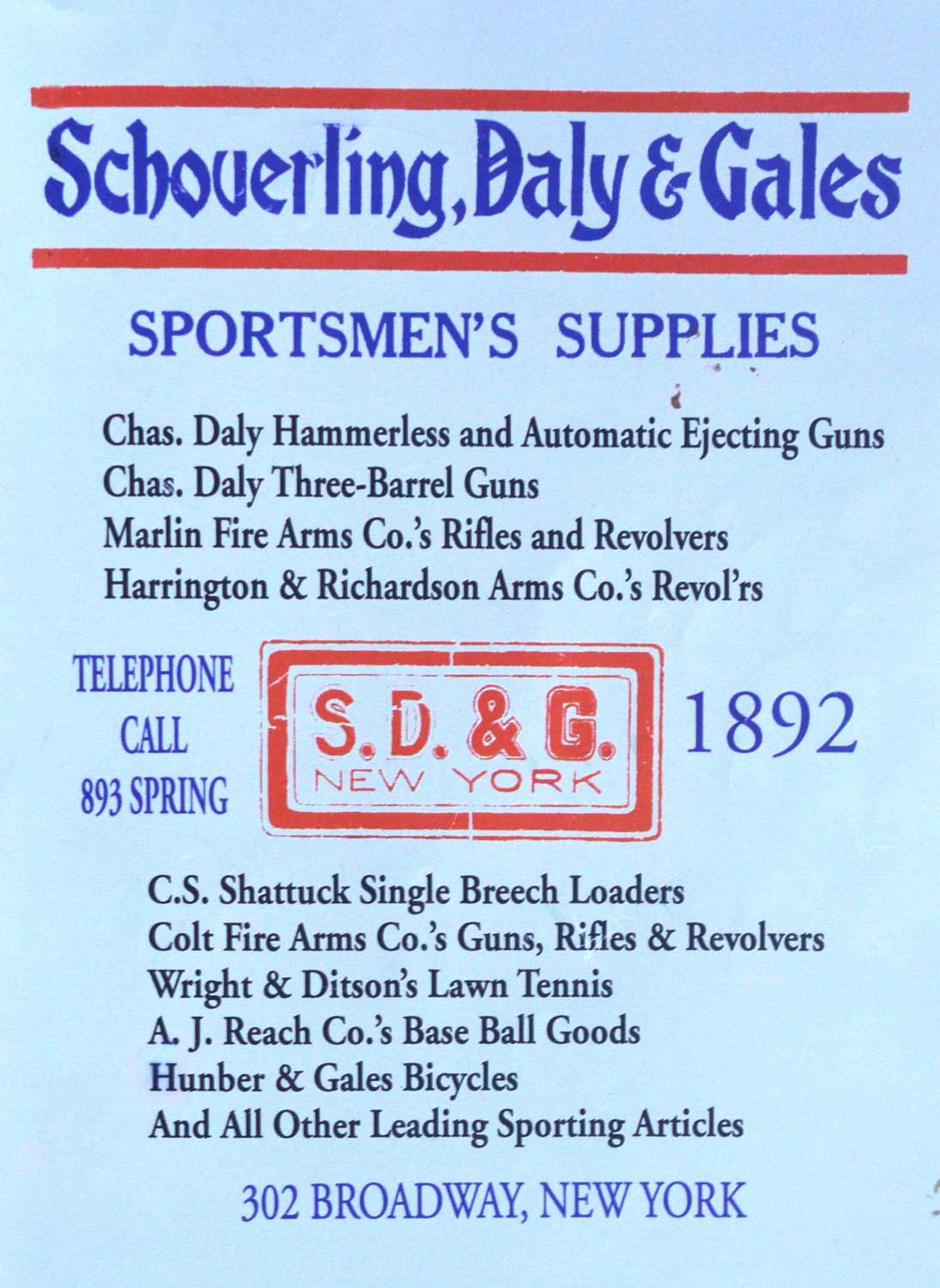
The company also established a successful sportsmen’s supplies catalog sales business that expanded its customer base. The 1892 catalog, after advertising Charles Daly hammerless guns priced from $110 to $275, offered models of W.& C. Scott and W.W. Greener hammerless guns priced from $115 to $475. Next it advertised models of hammerless doubles made by Lefever, Parker, Ithaca, L.C. Smith and Colt priced from $50 to $150.
S&D’s first imported doubles around 1870, primarily from British manufacturers. It is not known what motivated Charles Daly to move beyond standard retail practices of ordering shotguns from established makers and displaying them for sale. One reason may have been that the demand for British guns at this time exceeded the supply, and a retailer cannot make money if there is nothing on the shelves to sell. Another is that Daly understood that wealthy Americans and wealthy British did not necessarily want the same things in a shotgun. He may have been trying to solve both problems by securing a reliable supply source for high quality-shotguns that would sell well in America. Daly began exploring the potential of the sporting arms industry in Suhl, Germany, most likely because of Schoverling’s or his own personal contacts.
Sometime in the early 1870s, Daly found in Georg Lindner an accomplished custom gunmaker with whom to collaborate. Georg produced a limited number of guns of different design for Daly, in what we might today consider “doing due diligence” or “conducting a limited proof-of-principle” trial run before making a large investment. Georg Lindner was nearing retirement. He steered Daly to his 28-year-old son, Heinrich August Lindner, whom he had trained and in 1874 was just starting out on his own.
In 1875, H.A. Lindner registered a company in Suhl with his father’s assistance and Charles Daly’s financial backing. While details of the contractual agreement are unknown, Daly and Lindner had an active collaboration and agreed on the features that would be incorporated into their guns. Daly, who was a marketing genius and understood American sportsmen, defined the type of gun he wanted to produce. Lindner, who was a skilled practical gunsmith with an artist eye, designed it. In the end, both agreed on the features, Daly fronted the money, and Lindner began building guns exclusively for S&D.
Linder’s company can be more accurately described as “building” Daly doubles rather than “manufacturing” them. Its workshop was on the bottom floor of the family’s three-story home. Hans Pfingston describes the process in his two-part 2005 DGJ series, “Ghost or Gunmaker: The Mystery of H.A. Lindner:”
“In Suhl, Lindner was referred to as a ‘rucksack’ gunmaker who used his backpack to deliver and pick up gun parts from skilled workers living within walking distance…. Employing outworkers (experts working out of their homes or shops) was an efficient system practiced not only in Suhl, but in all large gunmaking centers, such as Ferlach, Austria; Birmingham, England; and Liege in Belgium. Today we would call H.A. Lindner a ‘custom gunmaker’ who supervised the fitting of barrels, actions and stocks, commissioned engravers, and inspected final assemblies.”
Production ceased in 1914. Lindner, who had lost his son during the war, did not restart when it was over. SD&G reached agreement with other Suhl gunmakers, most notably August Schueler, to take over production. The Charles Daly name was sold in the late 1920s to the owners of Sloan’s Sporting Goods, and thereafter to other companies marketing guns of varying design and quality under the Charles Daly label.

Charles Daly Hammerless Shotguns
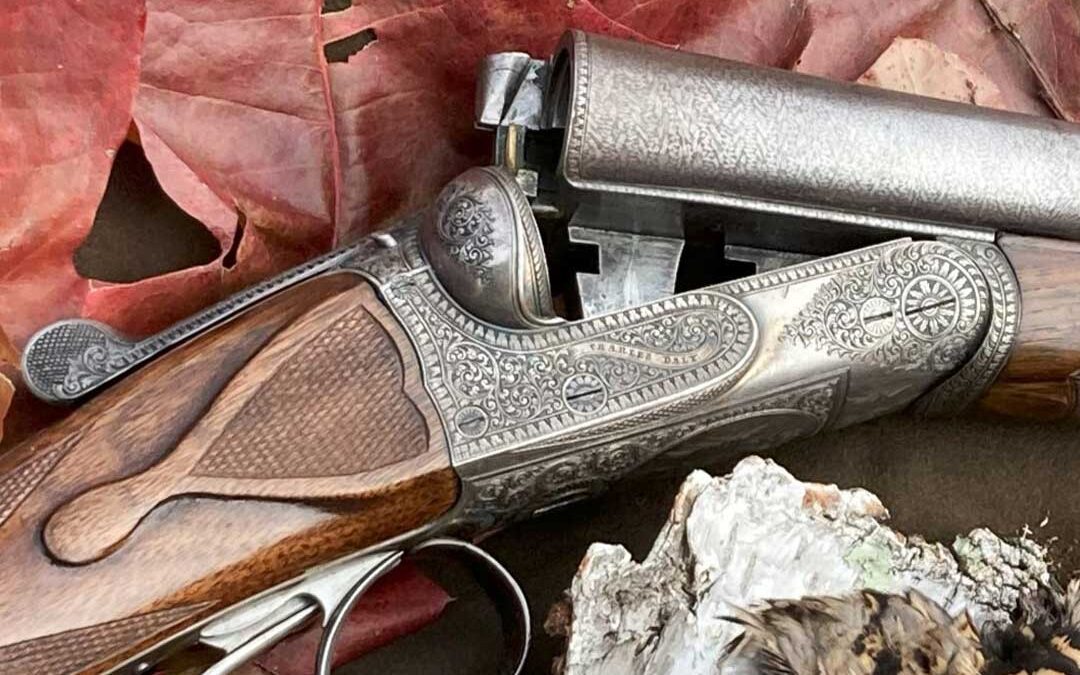
The Charles Daly Model 200 pictured on a fall day in a Wisconsin forest exemplifies the “timeless quality of beauty or design” of a classic double. The brace of woodcocks, generally considered the most challenging of upland game birds, is demonstrative of the superb functionality of Charles Daly hammerless game-guns.
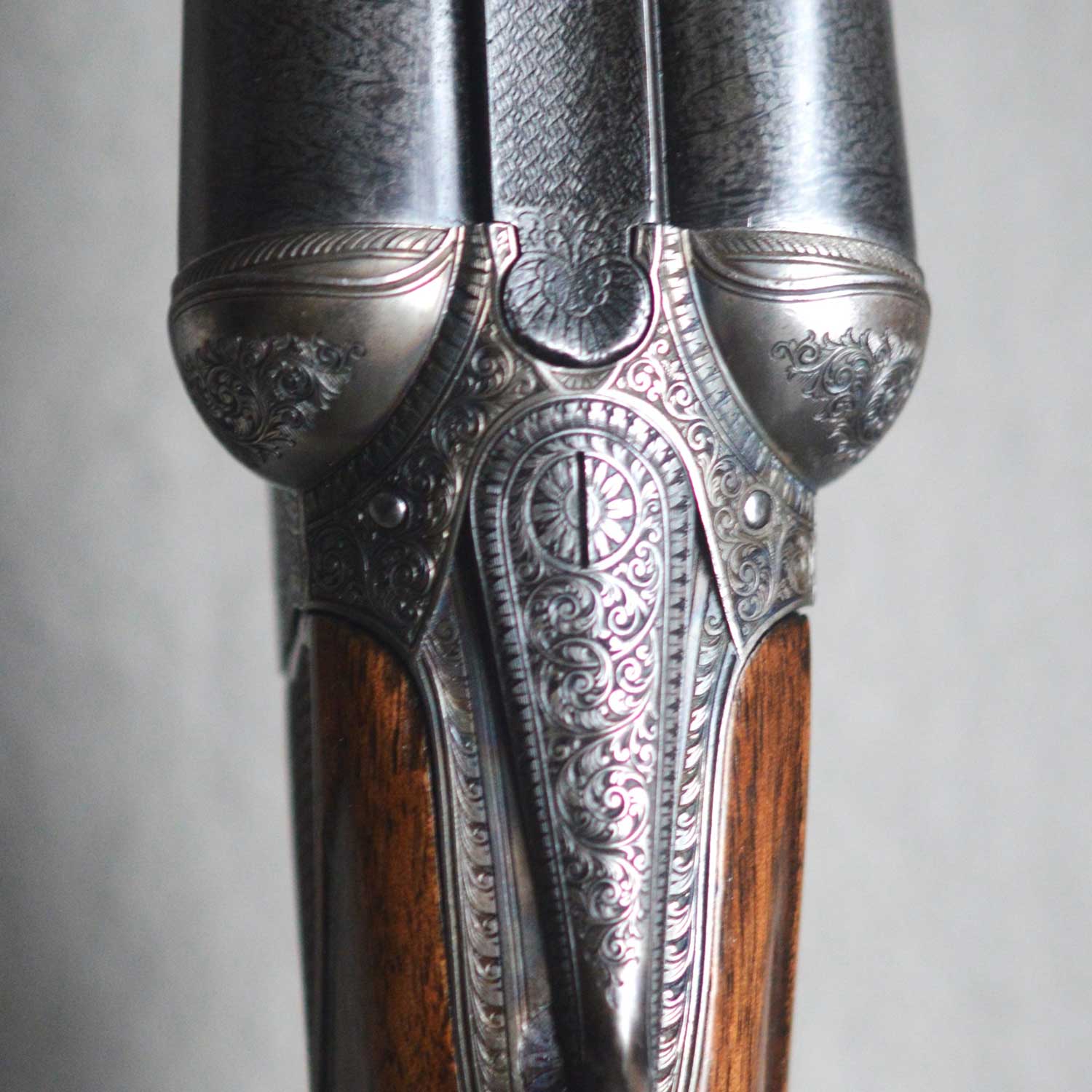
This Diamond quality gun was manufactured circa 1890 and listed for $175. The lowest quality Daly at the time, the Model 120, retailed for $110. The highest priced Daly, which was a Diamond quality gun with ejectors, listed for $250. Over the next 15 years, the number of Diamond quality models and their prices substantially increased. The 1907 SD&G Book of Fine Guns catalog lists five models of Diamond quality guns, Models 225, 275, 325, 375 and 500. The price of each model in dollars matched model number.
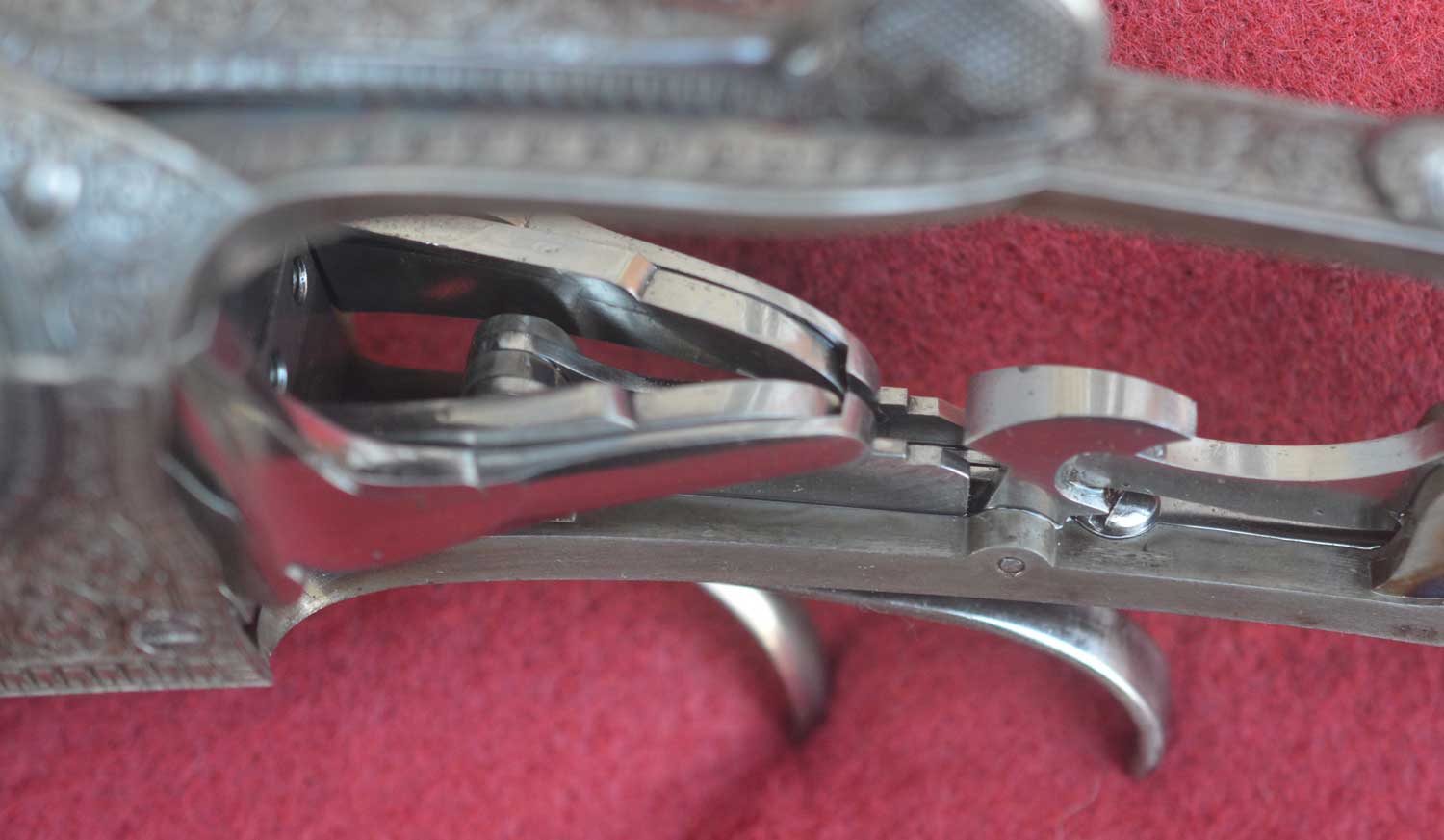
As with all Daly hammerless guns, this gun uses a modified Anson & Deely boxlock. One of those modifications was to make the body longer, which SD&G advertised as making the gun stronger. The receiver with bottom metal and locks weighs 1 pound, 13 ounces. The receiver itself is 1.65 inches wide, 2.5 inches tall and 3.75 inches long (not including the tang). Among the important safety features are double intercepting sears, which prevent accidental discharge, and cocking indicators.
The locks on this gun live up to the claims in the SD&G catalogs of the period, as cited in the Winter 1995 DGJ article by Bill Wise, “Diamonds and other Prussian Jewels:”
“We claim for the Daly gun greater strength of breech, more conscientious workmanship and closer fitting joints than any other make of gun.”
This claim could have added the quality of the steel used to make the mechanical components, without being challenged. German steel was the best in the world.
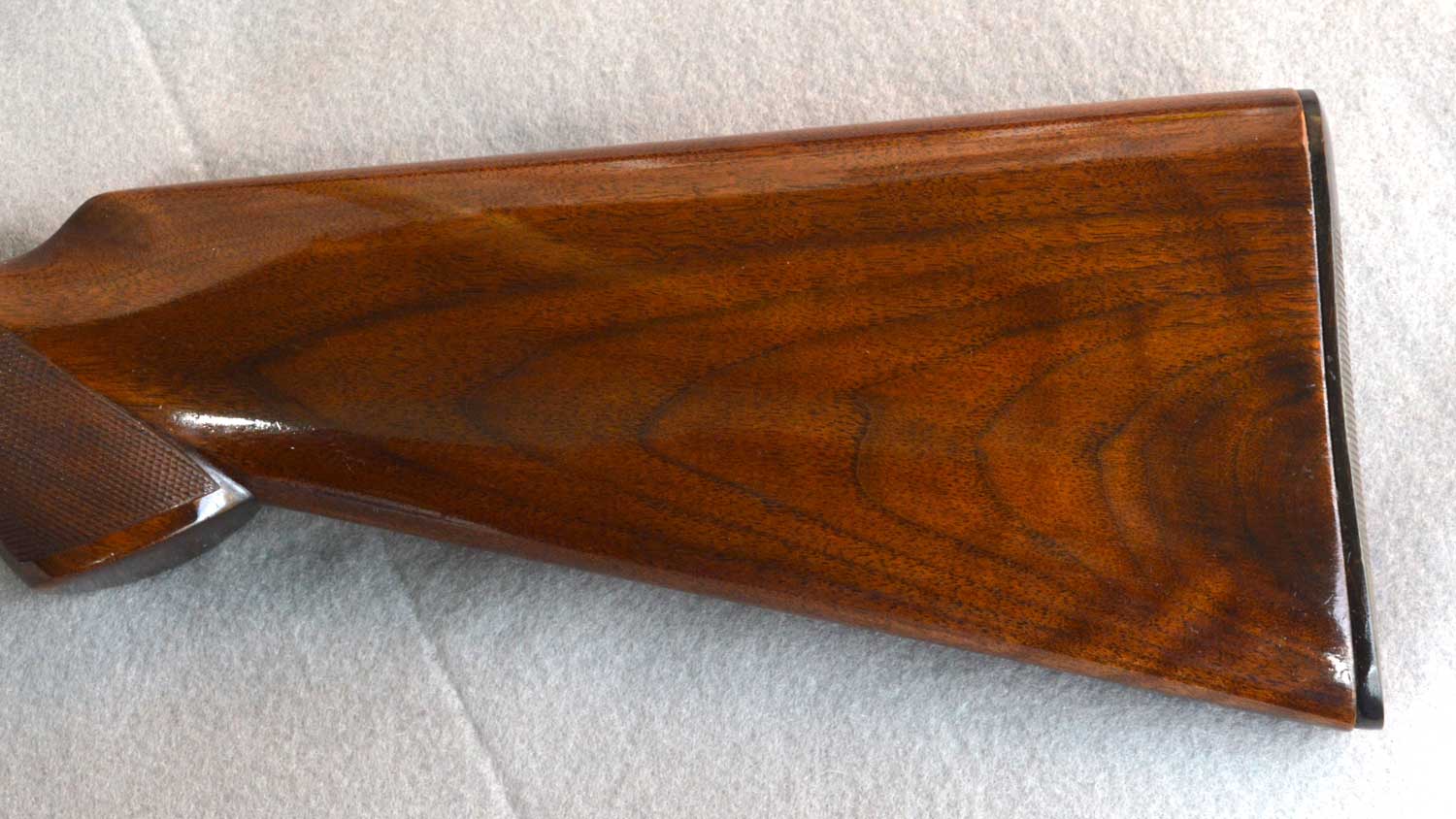
The stock is made of figured Turkish walnut (later Italian walnut was used on all Diamond quality guns). The grain alignment is perfect; this blank was cut for strength. The flow of the growth rings emerging from the figure conveys a sense of harmony. However, because the figure on the opposite side is not balanced, the stock would be a 3+. It has 32-point checkering and modern shooting dimensions. The length of pull is 14 1/4 inches to the end of a horn butt-plate. The drop at the comb is 1 1/2 inches and the drop at the heal, 2 3/8 inches.
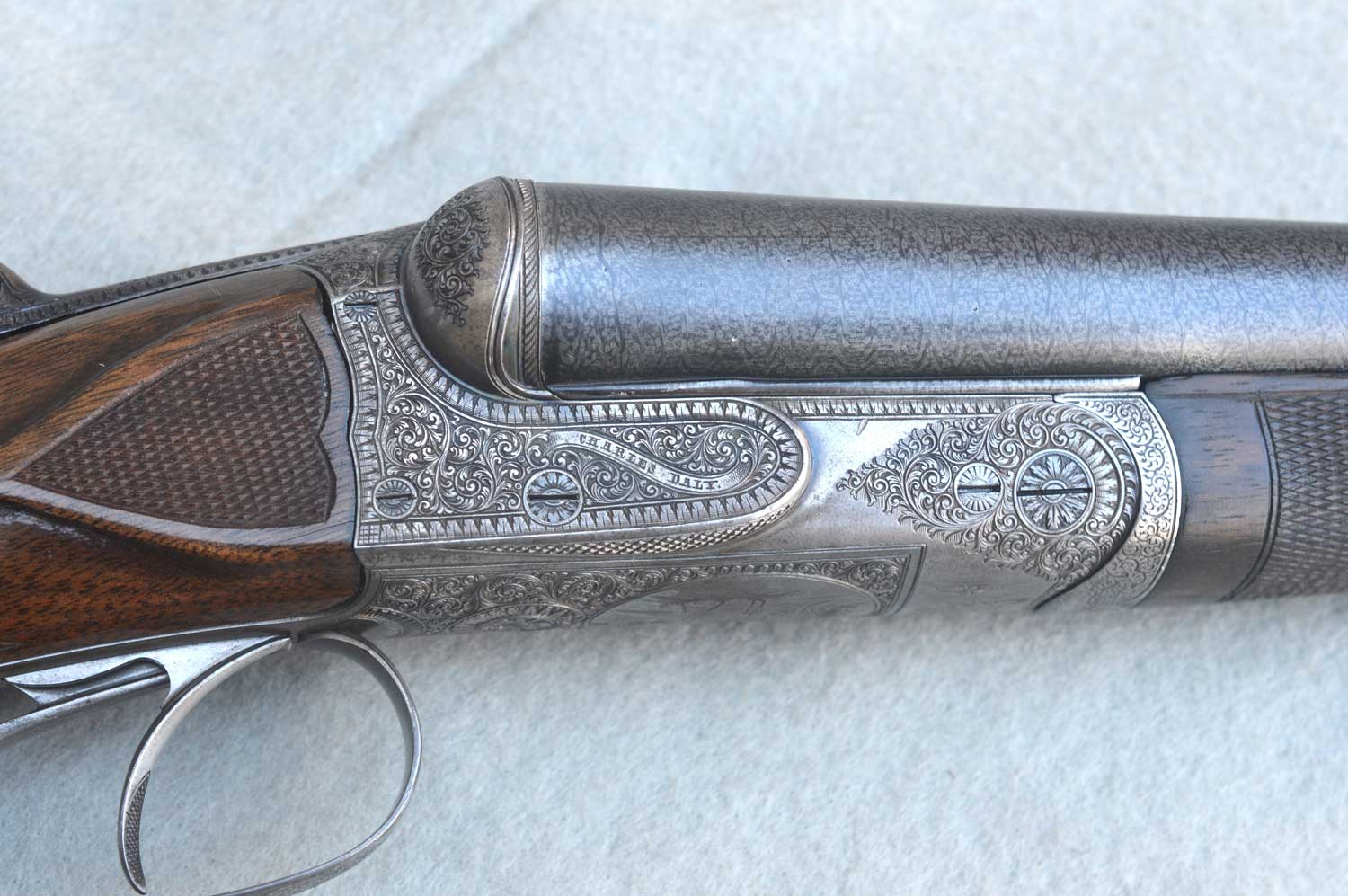
The barrels are made of Bernard Damascus steel, generally considered the best in class. They retain the original finish, in which the pattern appears in shades of grey rather than the standard high-contrast black-on-white. They have a dolls-head rib extension, are chambered for 2 3/4-inch shells and weigh only 3 pounds, 2 ounces.
Daly understood that American customers preferred classic English scroll and game scene engraving to classic Germanic deeply chiseled hunting scenes and oak leaves. Thus, English style engraving is dominant on most grades of Daly guns, although many have a stag, Alpine roebuck or other iconic Germanic hunting vignette showing on the bottom metal or trigger guard.
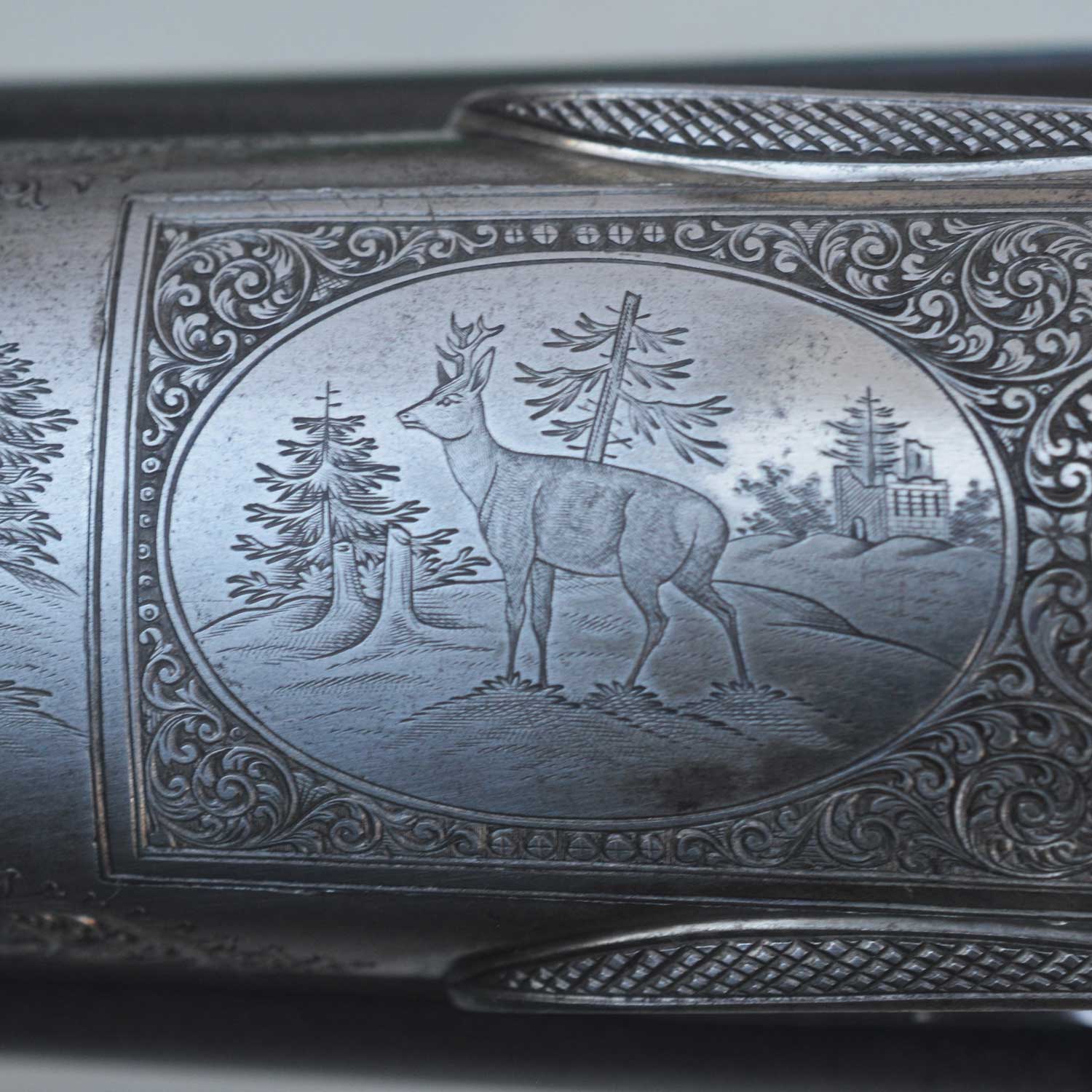
The style of engraving on this gun could be described as a fusion of classic English and Germanic styles. The scroll on the sides of the receiver is of English design, but it is deeply cut. The engraving on the tang and top-lever is English, but a stag dominates the bottom metal. The quality and coverage of the engraving speak for themselves.
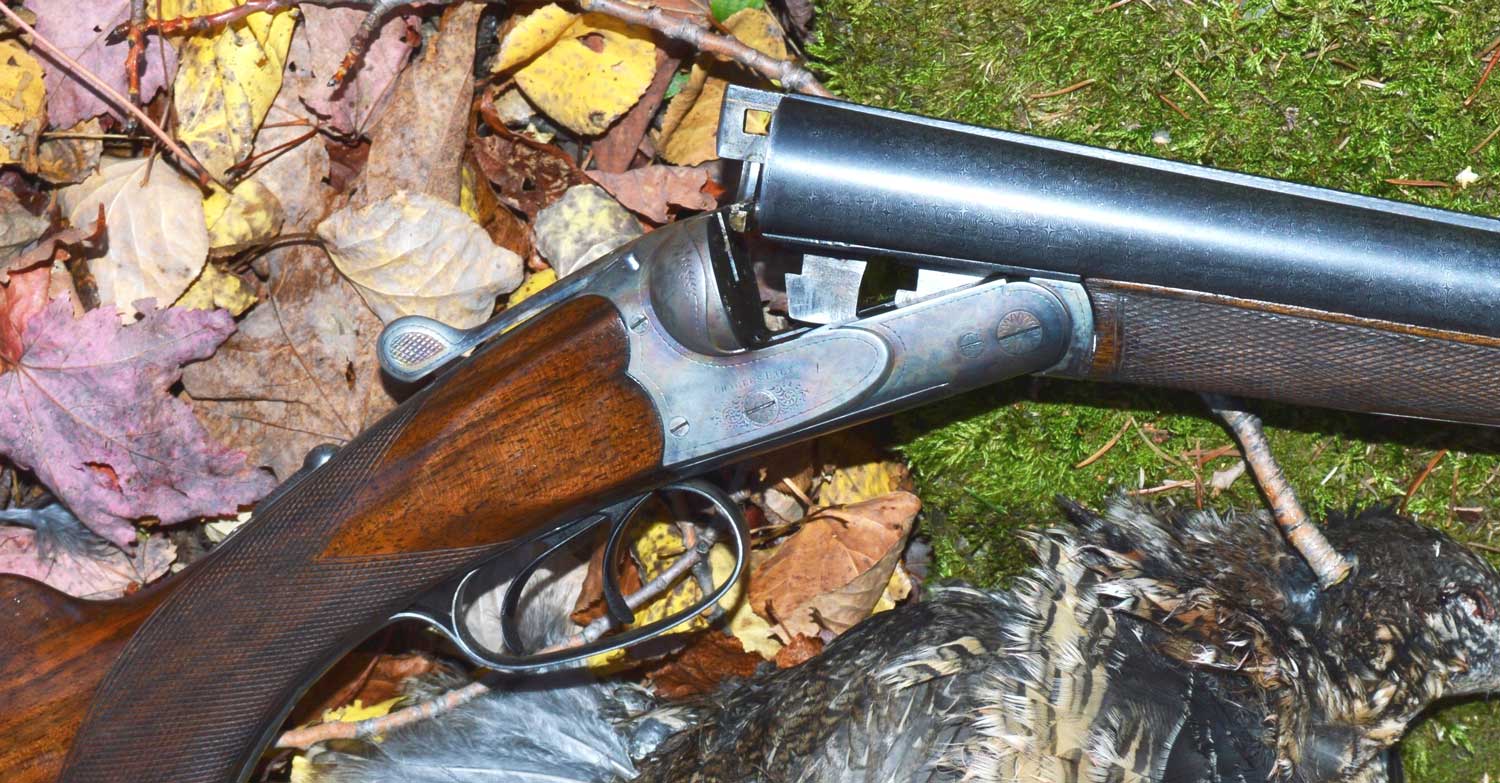
The Model 125 game gun was manufactured in 1900 and was priced at $140. It illustrates both continuity and change during the preceding decade. The receiver and modified Anson & Deeley action are unchanged, except for the addition of a rectangular cross bolt. This created a third lock binding the barrels to the receiver, a safety feature that had become industry standard on the Continent.
The barrels are fine 3-rod Damascus, but Daly also offered the option of Krupp fluid steel barrels then, which by 1905 were standard on all models. This particular gun was ordered with sling swivels fitted on the barrels and stock. This is a good indicator that the original owner bought it to use in the field, where it still performs very well.
Charles Daly Hammer guns
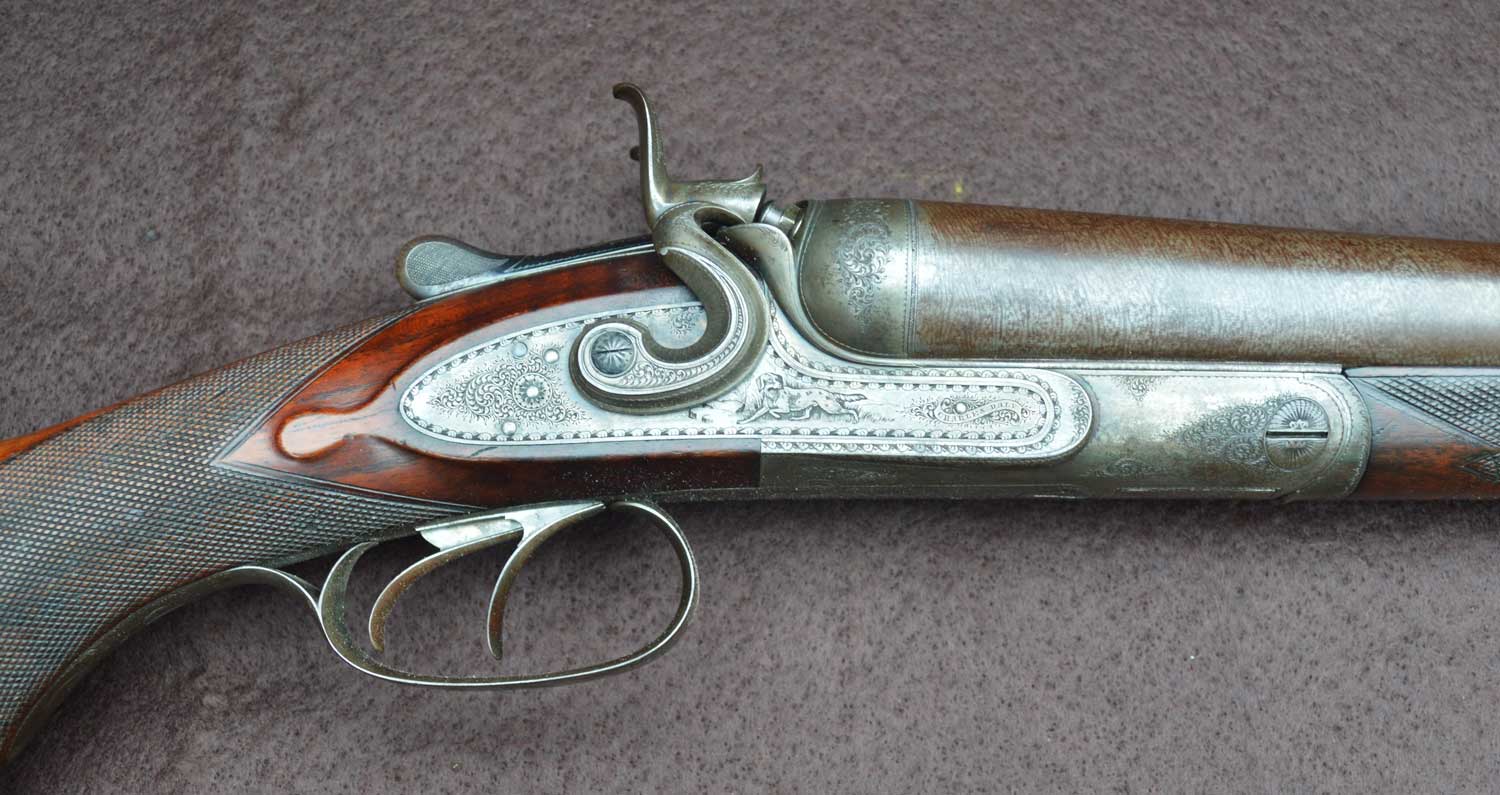
The origin of the earliest hammer guns bearing the Charles Daly name is unclear. Pre-H.A. Lindner Dalys do not have proof marks that identify national origin or maker’s marks. However, the author’s research has identified among the first 500 serial numbers, guns that are identical in design and component parts to Birmingham-made W.& C. Scott and Westley Richards models.
The early Dalys that were clearly built in Suhl are generally attributed to Georg Lindner. The variance in the actions among these guns indicates some degree of experimentation. Serial number 536, pictured at above is one example. Its graceful design, light weight (7 pounds, 2 ounces), slim receiver (1 1/2 inches wide) and Italian walnut stock are prescient of the hammerless guns later designed by H.A. Lindner and Charles Daly.
At some point before 1875, Charles Daly and Georg Lindner decided to use W.& C. Scott parts kits on Daly hammer guns. One example is the 10-gauge waterfowler serial number 1139. Like other early Daly guns, it has no proof or maker’s marks.
Their decision to build Daly hammer guns around Scott receivers and locks appears to have extended seamlessly into the H.A. Lindner era. Charles Daly 10-gauge serial number 1366 (not pictured), also uses Scott parts and is nearly identical to 1139. It is stamped with the H.A. Lindner cross-pistols logo.
Auguste Francotte & Son, Liege
Auguste Francotte began making guns in 1805 and continued being one of principal armaments manufacturers in Liege until Germany invaded Belgium in 1914. From the end of the Franco-Prussian War in 1871 to the start of World War I, like its counterparts in Suhl, Francotte redirected effort toward manufacturing sporting arms.
Francotte’s entry into the American market came through an intermediary, the U.S. firm of Von Lengerke & Detmold (VL&D). VL&D had a high-end retail store located on 5th Avenue in New York City. It carried fine shotguns, fly-fishing equipment and a range of sportsmen’s supplies. VL&D had much in common with SD&G. Both companies imported high-quality European shotguns, were located near each other and were patronized by the city’s wealthy sportsmen. Both also established successful high-end catalog-sales businesses.
In the late 1880s, VL&D became the sole U.S. agent for Francotte shotguns. This relationship, which is engraved on the top of the barrels of Francotte doubles exported to the U.S., proved to be very successful. The 1908 VL&D catalog states on its first page that:
“Our Francotte Guns are High Grade, Hand Made Guns. They are to-day the most popular and most modern of the various better makes of foreign made guns on sale in the United States. Practically unknown in America in 1890, records show that more Francotte Guns have been imported and sold during the last few years than guns of any other one make of equal costs.”
The company attributed the success of its guns, which it categorized as either “trap” or “field” guns, to its high quality and medium price. Regarding the field guns, it highlights that “they have proved safety and extreme lightness in 12-gauge guns can be combined with excellent shooting qualities.” Francotte had a London branch from 1877 to 1893, which may explain why its first exported game guns were of traditional British style.
Early VL&D Imports
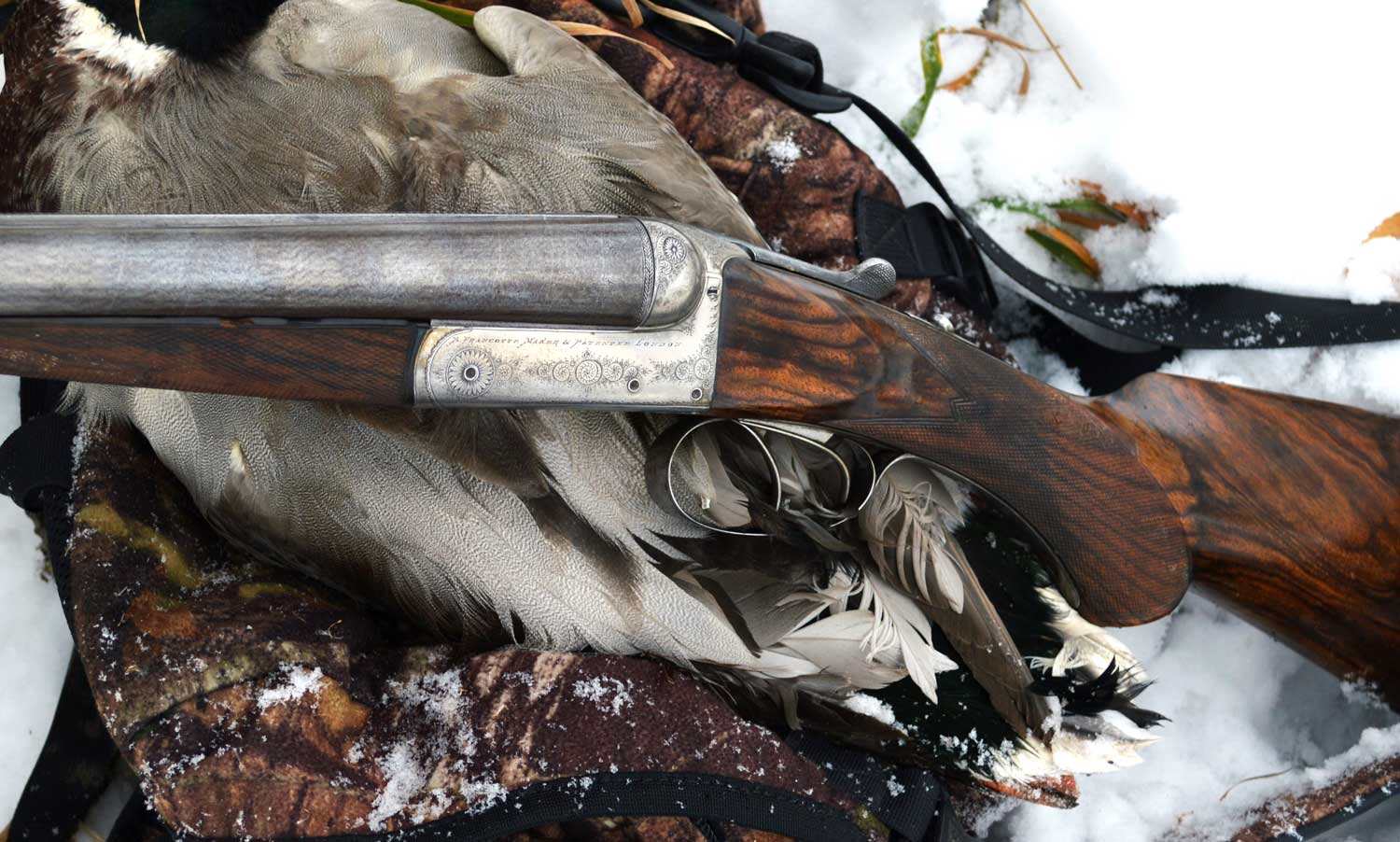
The boxlock game gun pictured with a mallard drake taken in Manitoba was manufactured in 1889. It was one of the first VL&D Francotte doubles to arrive in America. Both sides of the receiver are engraved “A. Francotte Maker & Patentee London.” The top of the right barrel is engraved “Von Lengerke & Detmold” and the left “U.S. Agents New York.” It weighs exactly 6 pounds and would have been one of the lightest doubles in the hands of American hunters at the time.
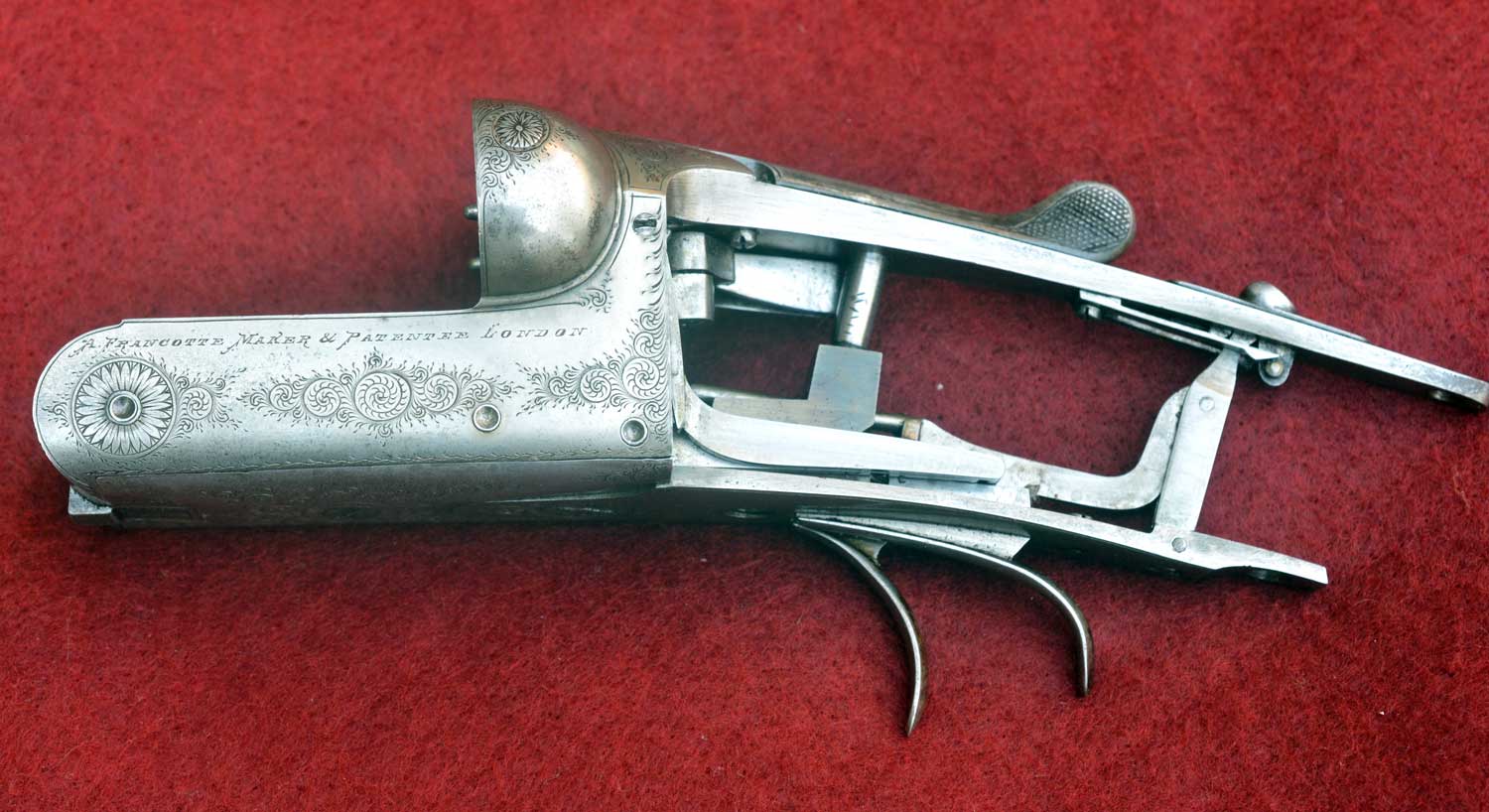
The lock is of Anson & Deeley design. It has a top-lever release mechanism and Purdey double-bolt operated by a Scott spindle. The Greener cross bolt and top rib extension lock the top of the receiver to the barrels. The double intercepting sears and other mechanical parts are made of finely machined tool steel. The receiver, locks and bottom metal weigh 1 pound, 10 ounces. The receiver is 1.5 inches wide, 2.3 inches tall and 3.4 inches long.
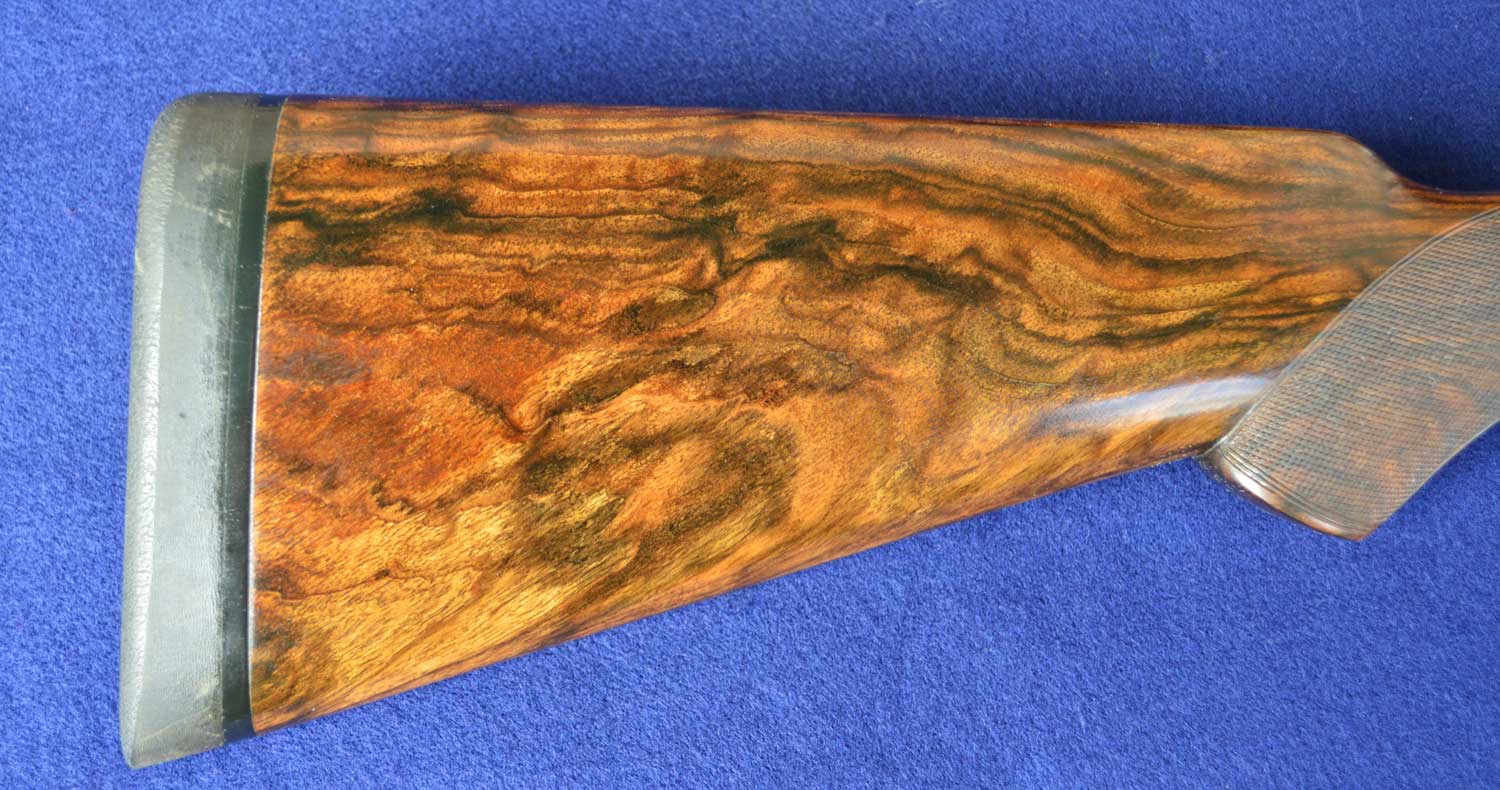
This stock is ascetically stunning. Its curled dark grain contrasted against a richly colored and highlighted background give it real charisma. Its greatest asset, however, is the perfect grain alignment through the wrist into the stock head. Overall, this stock is a 4+. The gun has a lot of drop, 2 inches at the comb and 3 1/4 inches at the heel. The length of pull is 14 inches.
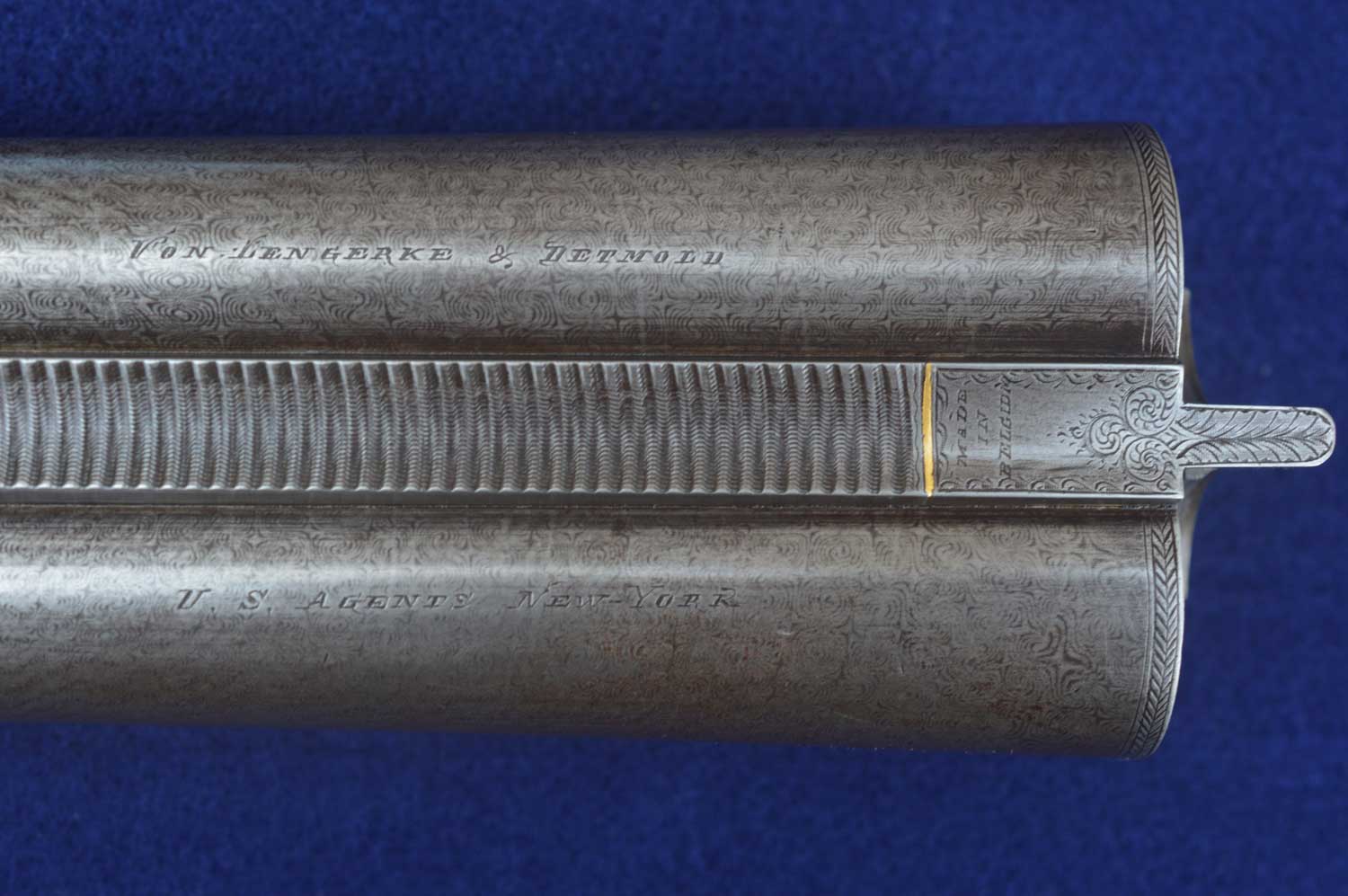
The barrels are extra-fine 4-rod Damascus, a quality level rarely found on a game gun, imported or domestic. The functional benefits of 4-rod barrels are less weight and greater strength. But the increased safety alone would have been a sufficient reason to special order this quality. The finish is original. The engraving, hand-matted top rib and gold band add a touch of elegance. The barrels are 70cm (27 3/4 inches) long and have 65mm (2 5/8-inch) chambers. The right barrel is not choked (cylinder) and the left is choked modified.
The engraving on the receiver and bottom metal is entirely English scroll of modest quality, especially when compared to the gun’s other three components. However, it is more than sufficient to serve its functional purpose, which is to reduce possible glare. The original buyer of this gun may have considered more intricate and extensive engraving to be unnecessary on a hunting gun, overly ostentatious or just not in style.
Later VL&D Francotte Doubles
The line of Francotte guns that followed the “London” guns were made in a more traditional Belgian style. The models varied during the two decades of production that preceded the German invasion in 1914.
VL&D’s 1908 catalog shows five standard models of Francotte game guns that are priced from $80 to $140, and five models labeled as “trap” that are priced from $175 to $300. Guns could be “made to order” if the client was willing to wait six months. Guns could also be modified to be “suitable for ladies.”
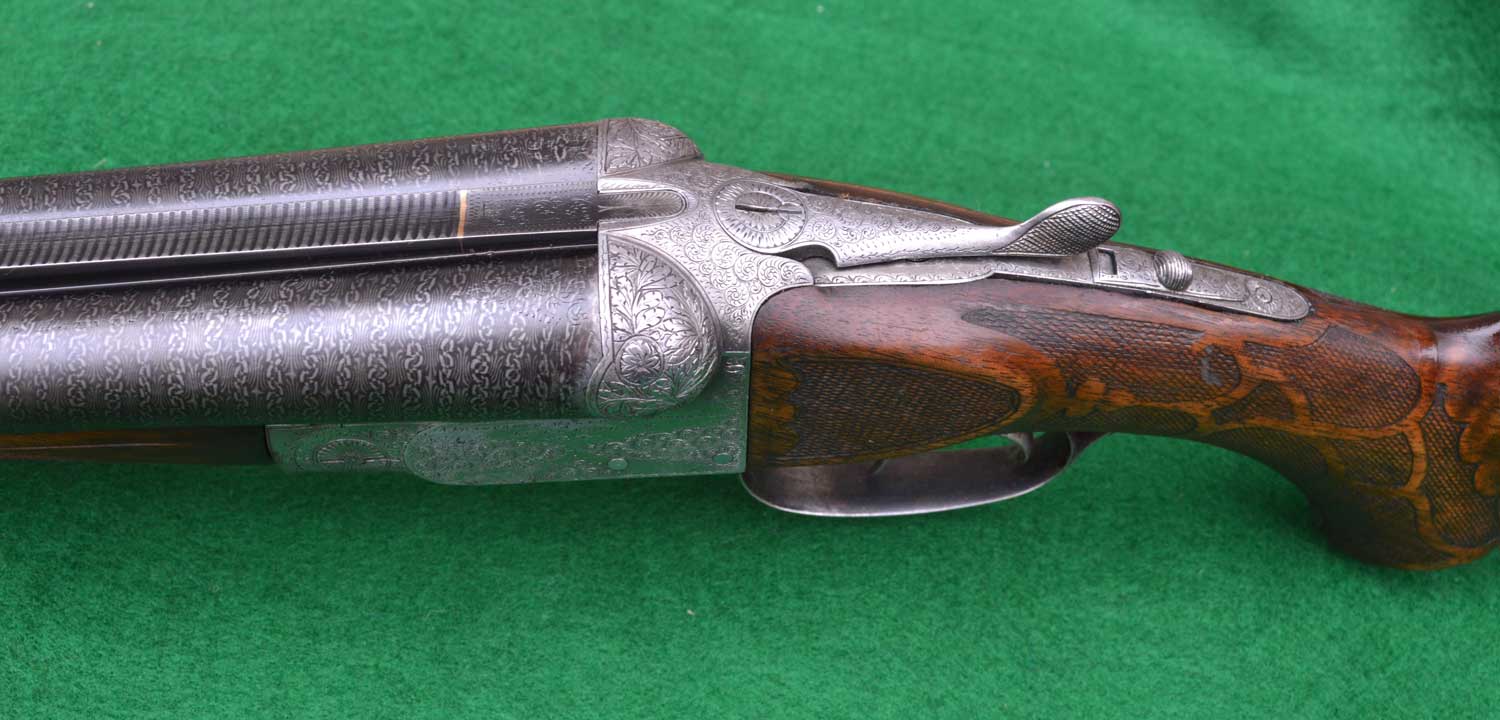
The 1895 game gun pictured here has 28-inch barrels and weighs 6 pounds, 10 ounces. The locks are similar to the 1889 Francotte. The gun also has a double underbolt and a Greener-style crossbolt. The frame is more angular (1.65 inches wide, 2.1 inches tall, and 3.1 inches long) and side clips have been added.
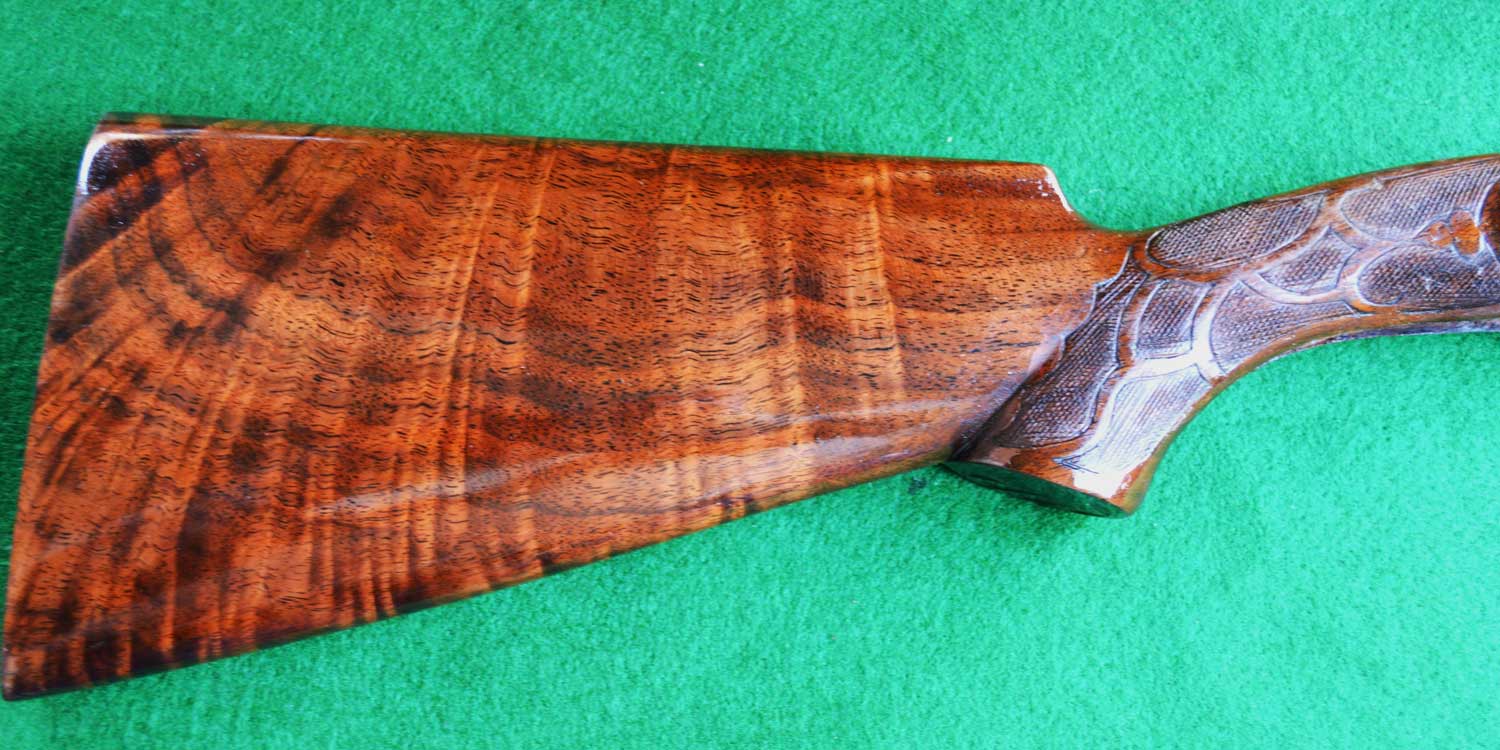
The English walnut stock has near perfect grain layout and exceptional esthetics. The most unusual feature of this stock, which rates a 4, is its darkly grained tiger stripes. A stock blank with these features could have been cut from where a branch entered the trunk of the tree or could have resulted from wind compressing and relaxing the branch. Either makes the stock very strong. The checkering between the attractive lattice work is 28-point. The stock’s shooting dimensions are modern; the drop at comb is 1 3/8 inches and at drop at heel is 2 1/4 inches. The length of pull is only 13 1/2 inches, suggesting that the gun may have been ordered for a lady.
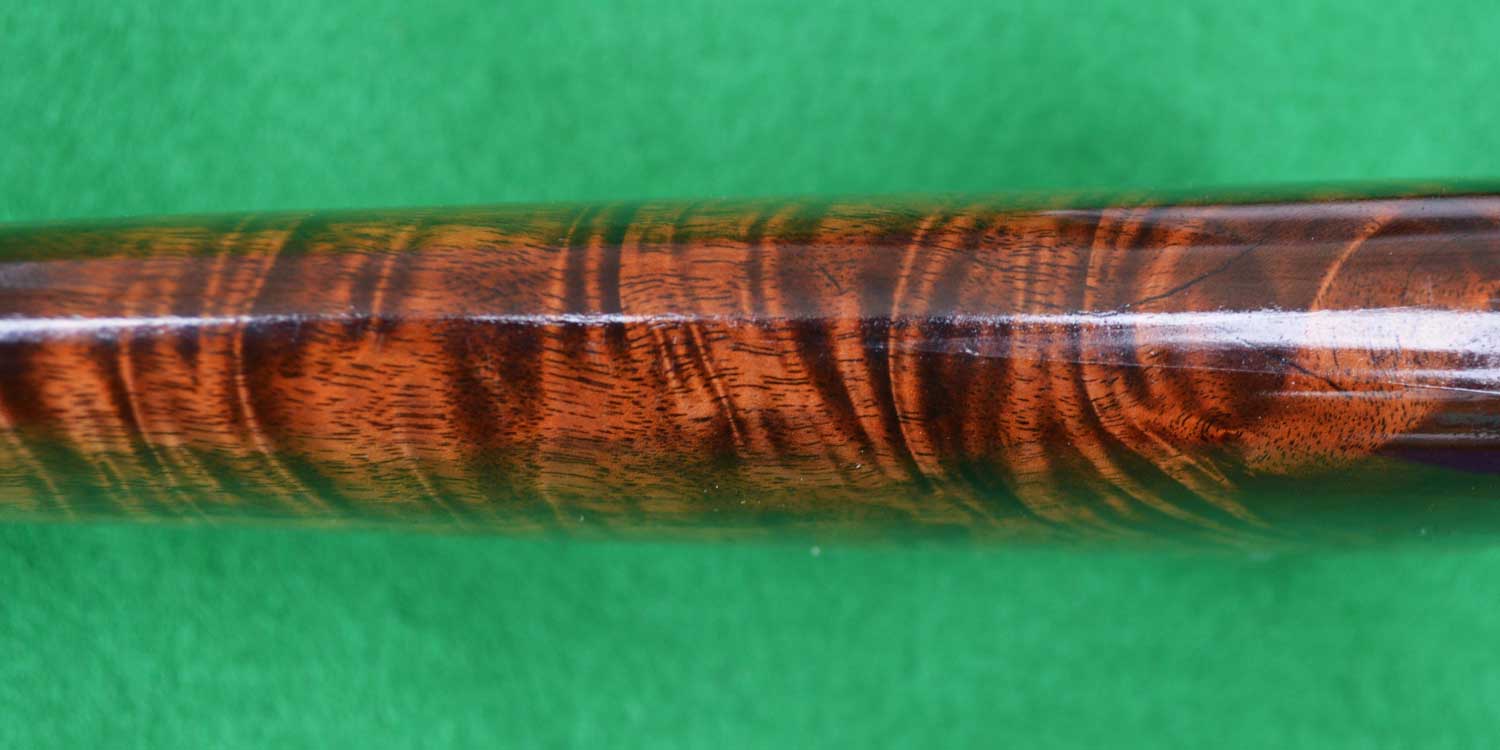
The barrels are made of fine Damascus steel in the popular chain-link pattern. They have 2 3/4-inch chambers and are choked improved cylinder and improved modified. The extensive engraving is primarily English scroll. However, the receiver balls are decorated with acanthus leaves, a classical motif used in Greek and Roman architecture that was popular around the turn of the century.
The First World War interrupted the importation of Francotte guns. After the war, Francotte manufactured a third line of doubles for export, the Jubilee. VL&D sold Jubilee guns from 1920 until it was purchased in 1929 by Abercrombie & Fitch, which continued selling them under its own name. Jubilee models No. 14 and 18 are true boxlocks similar to the pre-World War I guns. Models No. 20, 25, 30 and 45 are boxlocks with sideplates and can be distinguished from each other primarily by the extent and quality of the engraving. Pre-1915 Francotte doubles, which have serial numbers below 57000, are overall of higher quality than later guns and are today rarer.
The author would like to thank Daniel Miranda at Dunlap Woodcrafts, who has for more than 25 years provided high-quality stock blanks to custom gunmakers, for sharing his expertise in determining wood quality and other contributions to this article.